Up in the air
We’ve seen helium baked off a rocky exoplanet’s atmosphere
If the large, rocky planet is losing helium, then we can infer what is left behind.
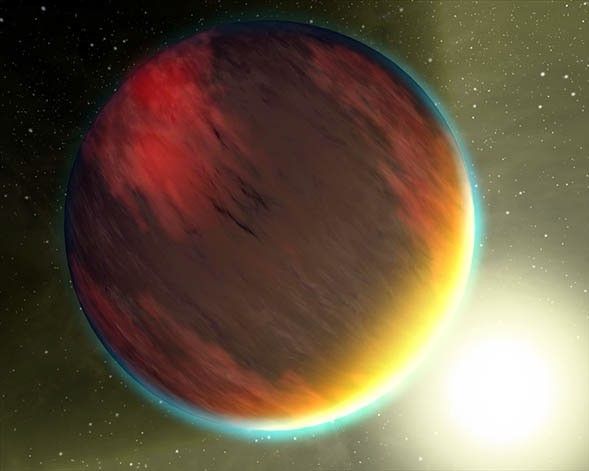
Most of the gas in the Universe is a mixture of hydrogen and helium. It’s thought that the initial atmospheres of most planets also start out that way. However, over billions of years, as planets evolve, the composition of their atmospheres may shift. Hydrogen can react with other chemicals, and both it and helium can be lost to space. Venus, Earth, and Mars are thought to have second atmospheres, with their original hydrogen/helium envelopes having been lost and/or transformed.
The dynamics of loss are complicated. Lighter elements are lost more easily, but hydrogen can be protected by being incorporated into molecules like methane and ammonia. The gravity of the body can help retain some molecules, and a magnetic field can limit radiation’s ability to blast material out of the atmosphere. Proximity to a star will matter too, both because of the radiation it produces and because it can heat the atmosphere and expand it to where gravity’s influence is less substantial.
Given all these complications, it can be difficult to know what to expect to find on exoplanets. But a study in Wednesday’s issue of Nature describes observations of helium being lost from the atmosphere of an exoplanet orbiting the star LHS 1140, about 50 light-years away. Based on the rate at which the helium is being lost, we can infer something about the remaining atmosphere.
Maybe an atmosphere?
LHS 1140a is a red dwarf star with two known planets orbiting it. One of them, LHS 1140c, is close to the star, completing an orbit in a bit under four days and receiving about five times more radiation from its host star than the Earth receives from the Sun. Also, a second planet, LHS 1140b, is considerably farther out. It takes nearly 25 days to complete an orbit. That places it significantly closer to its host star than Mercury is to the Sun. Because LHS 1140a is such a dim star, this means it receives less than half as much light from its star as the Earth does.
If all of that light ended up heating the planet, it would be warm enough to have liquid water on its surface.
We’ve tracked LHS 1140b through its gravitational influence on its host star and by watching it transit across the front of the star from Earth’s perspective. This data indicates it’s about five-and-a-half Earth masses and has a radius that’s 1.7 times Earth’s. That’s consistent with a roughly Earth-like composition, with a lot of rocky material and either a significant amount of water and/or atmosphere (with the exact amount depending on how much iron).
We’re unsure if LHS 1140b has an atmosphere, much less know anything about its composition. We know that the system appears to be at least 3 billion years old, which has given the atmosphere ample time to evolve. Red dwarfs are also prone to outbursts where they emit lots of energetic radiation, and the planets have had lots of time to experience those, as well.
That was the backdrop against which a team of US-based researchers searched for helium as LHS 1140b orbited its host star.
Coming and going
Imaging exoplanet atmospheres is difficult because the amount of the host star’s light that goes through them is tiny relative to the amount that comes to Earth directly from the star. Looking at a red dwarf improves matters, since there’s less light overall, and planets are relatively larger compared to these small stars. So, a red dwarf with two known planets made for an appealing target. To image it, the researchers used near-infrared imaging hardware attached to a telescope at the Las Campanas Observatory in the Atacama Desert.
The images included before, during, and after LHS 1140b and LHS 1140c were undergoing a transit, as well as images taken when they were elsewhere in their orbit. Helium was not apparent during LHS 1140c’s transit but showed up both before and after the transit of LHS 1140b. The helium signal extended well beyond the planet’s radius, which the researchers suggest is a sign that LHS 1140b has both a leading and a trailing tail of helium.
(While a tail drifting off behind the orbit of the planet makes intuitive sense, it’s possible that magnetic interactions and the stellar wind have been observed driving the creation of leading tails in other systems.)
The researchers interpret the tails as a sign that helium is currently being driven out of the atmosphere by the high-energy radiation the star produces. They confirmed this is possible using observations of the star made with the X-ray imaging satellite XMM-Newton. They estimate that the current escape of helium amounts to about 100,000 kilograms a second, relatively close to a rate that would have eliminated an atmosphere that was initially 1.5 percent of the total mass of the planet. As red dwarfs are even more active in their early years, it’s likely that the loss rate was even higher at some points in the past.
That said, helium couldn’t be detected when they repeated the observations a year later (this doesn’t mean it wasn’t there; it was just below the detection limit). So, there’s lots of variability in the atmosphere loss, which may explain why we’re still seeing it.
The leftovers
The fact that helium is being lost at all actually tells us something about the composition of the atmosphere. If there were still lots of hydrogen present, it would be absorbing a lot of the radiation and acting as a shield that protects the helium. The fact that LHS 1140b is losing this much helium suggests there is little to no hydrogen left in the atmosphere.
At the same time, the rate of helium loss provides some indication of the amount of energy available to liberate other atoms. The researchers suggest that nothing with an atomic mass above nine would be able to escape the atmosphere. This means that even atomic versions of oxygen and nitrogen would be retained. Any molecules, including ammonia, methane, and water, would also stay in the atmosphere.
Overall, they’re left with a picture of a large, rocky planet that has a helium-rich upper atmosphere, with any unreacted hydrogen lost long ago. Beneath that, there’s likely to be a thicker atmosphere, but we have no idea what it’s composed of.
The researchers wrap up by mentioning the concept of what has been called the cosmic shoreline: the boundary between where a star’s radiation bakes away any atmosphere, leaving an airless rock, and where the lower radiation can combine with favorable conditions to make atmospheres stable for billions of years. We now know that the cosmic shoreline in this exosolar system lies between LHS 1140c and LHS 1140b.
Science, 2026. DOI: 10.1126/science.aea9708 (About DOIs).