Amur does not go BRRR
Will Russia’s answer to the Falcon 9 rocket ever take flight?
Grasshopper-like tests could begin in 2028.
Credit:
GK Launch Services
Credit:
GK Launch Services
Everyone seems to be launching and landing rockets these days.
Last week, China joined the club of countries that have launched an orbital mission and brought its booster safely back to Earth, which is just the beginning of public and private ventures in that country aggressively pushing into rocket reuse. Also in Asia, Japan’s space agency has been conducting hop tests, and Honda recently performed vertical reuse tests.
In the United States, of course, SpaceX launches and lands reusable rockets every few days. Blue Origin, although its New Glenn booster is temporarily grounded, has also demonstrated the ability to both land and re-launch a large orbital booster. Other US companies, including Stoke Space, Rocket Lab, and Relativity Space, are all making credible progress toward partially or fully reusable rockets.
So what about Russia, which boasts a storied history of spaceflight and conducted the world’s first orbital launch nearly seven decades ago? There was some news this week from Russian space officials, but it does not exactly bolster confidence.
Waiting on Amur
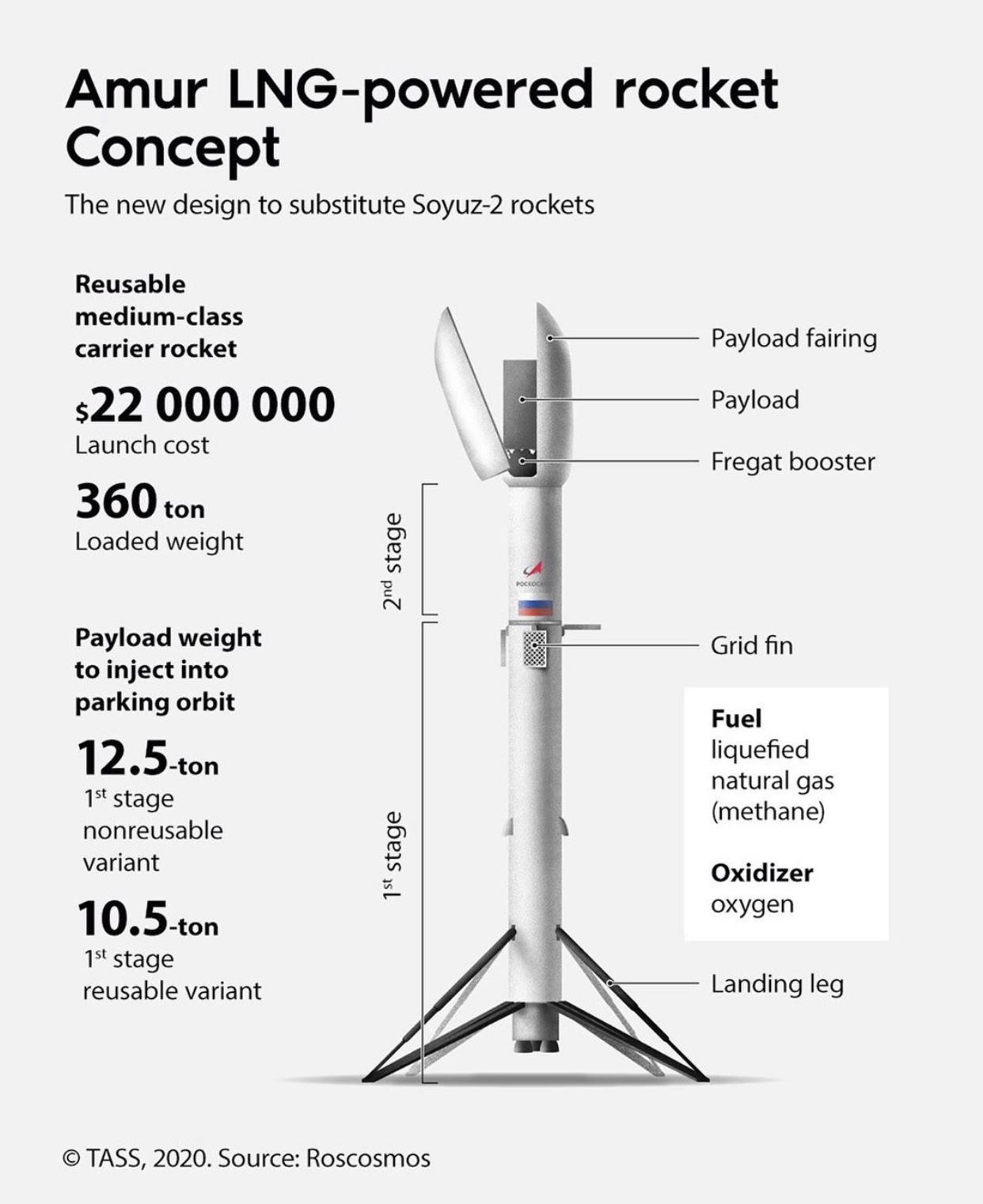
Nearly six years have now passed since the state-backed Russian space corporation, Roscosmos, unveiled plans to develop a reusable rocket called “Amur-LNG.” Clearly designed in response to SpaceX’s Falcon 9 rocket, Amur was intended to have a reusable first stage, methane-powered engines, and be capable of delivering 10.5 metric tons to low-Earth orbit in reusable mode.
At the time, Russian space officials said they planned to debut the rocket in 2026, so basically right about now.
This week, in an interview with the RBC business publication, a senior Russian rocket official provided some new information about the developmental timeline for the Amur rocket. Dmitry Baranov, Roscosmos’ Deputy Director General for Rocket Programs, said the current focus is on developing a “demonstrator” for the first stage of the rocket.
This hopper vehicle, likely reminiscent of SpaceX’s Grasshopper test bed, is intended to undergo two tests beginning in 2028. During the first of these, the vehicle will rise to an altitude of less than 1 km, with its engine running the whole time, before returning to the location it launched from. The second test will be more ambitious, with the rocket launching to 10km, shutting off its engine, and then restarting to land on deployable legs.
Such a timeline seems plausible, as Russian officials have previously disclosed that the RD-0169A rocket engine intended to power the Amur rocket is in the preliminary stages of test firings.
Soyuz 2 is probably safe for now
The goal is for this vehicle to, in Baranov’s words, “definitely and fairly quickly” replace the Soyuz 2 rocket that is presently the workhorse of the Russian space program. This rocket is currently used for both Russian crew and cargo launches to the International Space Station.
When might that happen? Baranov did not offer a new target date in the interview. But earlier this year, we got an indication from the Roscosmos State Corporation’s booth at the International Security Forum in May. A placard about the Amur-LNG rocket indicated that it would begin flight tests in 2031.
To summarize, when the Amur rocket was announced in 2020, its flight date was scheduled for 2026. Some six years later, its projected launch date has moved five years into the future.
The only reasonable conclusion is that Russia’s answer to the Falcon 9 rocket will not arrive any time soon, and it is unlikely to do so until at least two decades after SpaceX first landed an orbital rocket.