Amelia Earhart’s Airplane or a Coconut Tree? New Expedition Seeks the Truth

It’s been 89 years since Amelia Earhart disappeared while attempting to become the first female pilot to circumnavigate the world, and despite numerous attempts, her airplane has still not been found.
This past weekend, Purdue University announced that it is setting off for Nikumaroro, a remote island in the Pacific Ocean close to where Earhart sent her final, desperate radio messages.
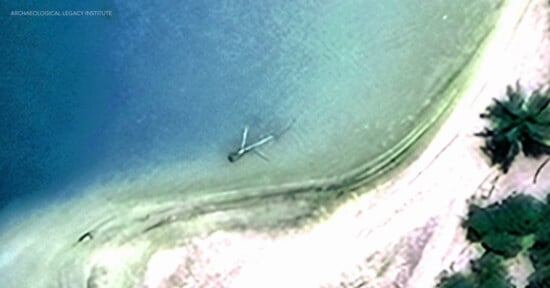
The expedition was prompted by a satellite photo of Nikumaroro that shows an object lying next to it that looks a bit like an airplane. The photo was taken in 2016 after a storm had shifted the lagoon’s sands.
Known as the Taraia object, it could be a coconut tree. However, expedition leader Richard Pettigrew believes that it could be the wreckage of Earhart’s plane, who disappeared along with navigator Fred Noonan on July 2, 1937.
“The evidence supporting the Nikumaroro Hypothesis remains compelling, and the only way to answer this question is to go to Nikumaroro, inspect the Taraia Object firsthand and follow the evidence wherever it leads,” Pettigrew says in a statement.

It will take Pettigrew and his crew six days by boat to travel the 830 nautical miles from Tarawa, Kiribati, to reach the island. They leave October 7 and plan to spend multiple days there, according to Today.
Other Evidence
The mystery satellite photo is not the only piece of evidence that Earhart crash-landed on Nikumaroro. In 1940, human skull and bones were discovered on the island, which a 2018 analysis strongly suggested belonged to a woman; the actual skeleton remains have been lost.
Other artifacts found on Nikumaroro include a woman’s shoe, a compact case, a freckle cream jar, and a medicine vial — all dating to the 1930s.
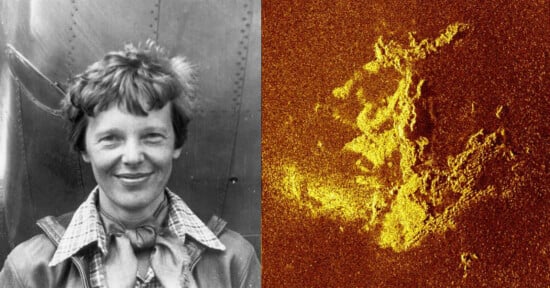
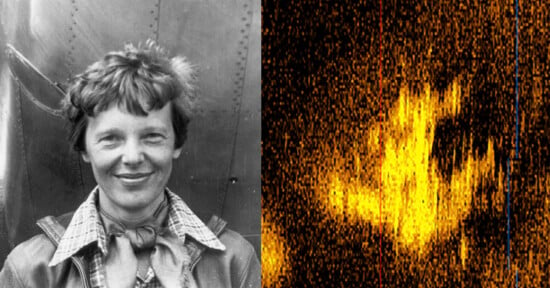
The expedition will bring sonar technology and magnetometers to search Nikumaroro, hoping to finally solve the mystery of Earhart’s Lockheed Model 10 Electra. But there has been false hope before. In 2024, a crew searching for Earhart got excited when an underwater drone captured what looked like the outline of an airplane on the floor of the Pacific Ocean. But it turned out to be a rock formation that looked a bit like an aircraft.