Another Photo Contest Falls Victim to a Controversy of its Own Making
DarkSky International’s Capture the Dark 2026 photo contest undoubtedly featured some beautiful photos of the night sky captured by talented photographers. However, since the winners were unveiled last week, controversy has reared its ugly head.
Photo contests can be a real hotbed of issues, and this year has seemed especially rife with troubles, especially ones related to the use of AI.
While the most noteworthy contest to deal with rule-breaking was Hasselblad Masters, which had to disqualify an entrant for using generative artificial intelligence (AI), there have been others. A very suspicious photo was removed from the National Wildlife Federation’s (NWF) Garden for Wildlife Photo Contest in May. Tokina pulled a winner from its contest earlier this year because of AI.
However, in Capture the Dark 2026’s case, the issue that has photographers online talking is thankfully not AI, but that some winners didn’t follow the competition’s own rules.
The Capture the Dark 2026 photo contest, as in prior editions, prohibits certain compositing techniques across the competition’s categories. Specifically, composites cannot mix focal lengths. Combining multiple exposures is perfectly acceptable, which is a good thing given its ubiquity in astrophotography.
But the rules prohibit photographers from the following actions:
- Merging images from different locations or nights (except for the Deep Sky category).
- Mixing focal lengths.
- Combining daytime foregrounds with night skies.
- AI-generated or heavily AI-assisted images that alter or generate scene elements.
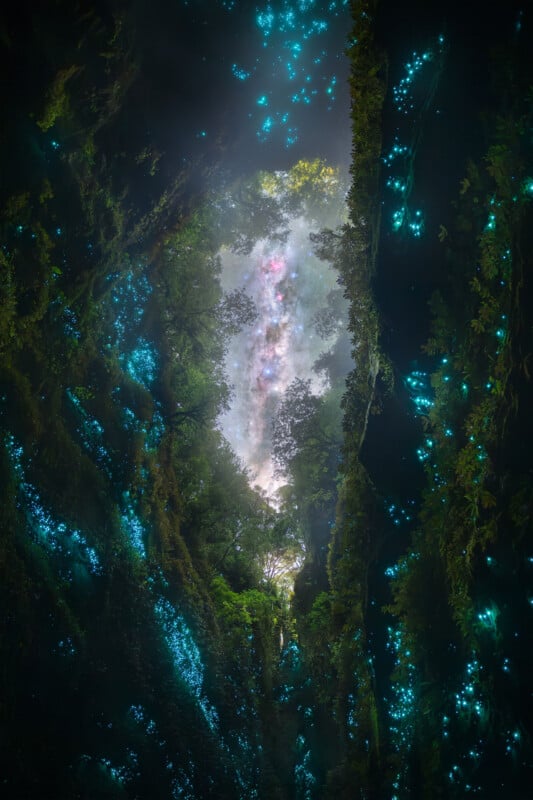
Among this year’s winning photos, the first-place image in the “Creatures of the Night” category, Tom Rae’s The Chasm, was created by merging images shot with multiple focal lengths.
This is explicitly stated in the Capture the Dark 2026 winner’s gallery itself.
The published EXIF data lists that Rae used two cameras, a Nikon Z8 and a Nikon Z7 IIA, and two lenses, the Nikkor 20mm f/1.8 and an adapted Sigma 40mm f/1.4. These obviously have different focal lengths, which is technically against the competition’s rules.
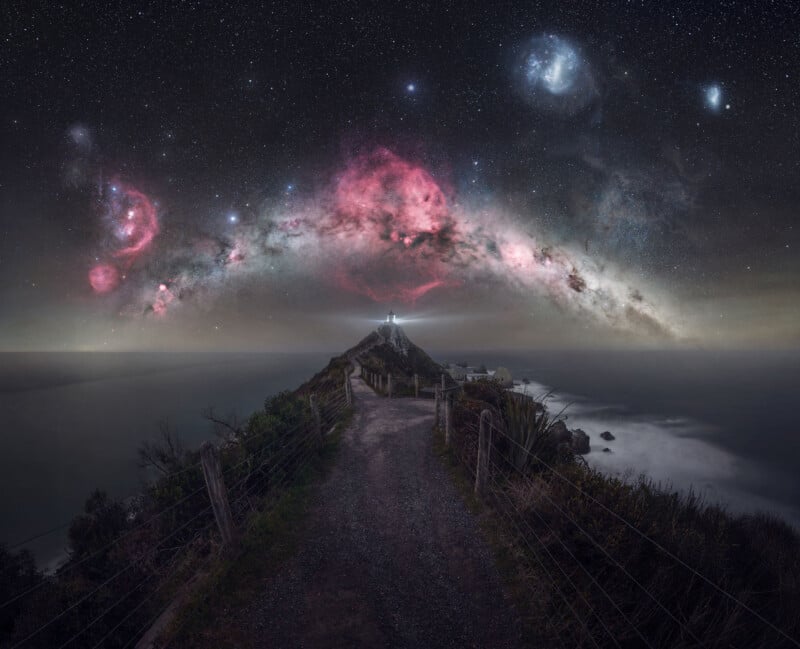
A second winning image, the second-place photo in the “The Impact of Light Pollution” category, runs afoul of the same thing.
Mikel Iraeta explains that he used the Nikkor Z 20mm f/1.8 lens for his sky photo and the Laowa 10mm f/2.8 wide-angle prime for his foreground.
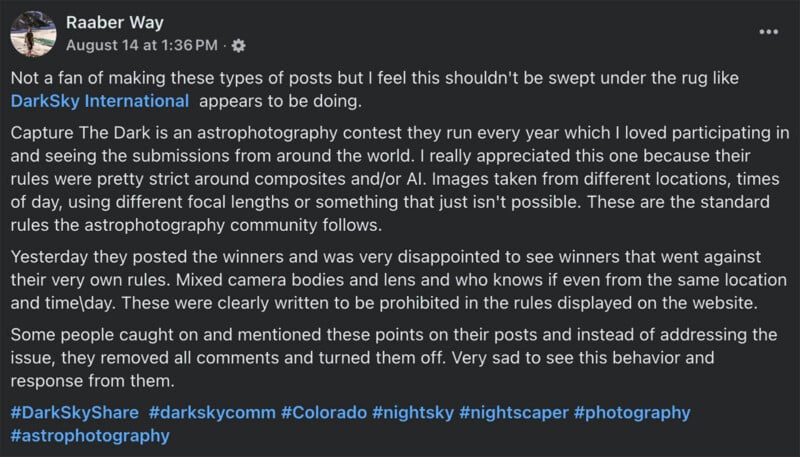
Unsurprisingly, some photographers are not happy that photos that violate the Capture the Dark competition’s rules have won awards.
It is worth making something abundantly clear here. Photographers like Rae and Iraeta could have entered the Capture the Dark 2026 photo contest without realizing their entries technically broke competition rules. They are both talented, experienced photographers who entered beautiful photos they actually captured with real cameras and lenses. It seems unlikely they would have entered violating images without attempting to hide what lenses they used had they realized any rules were being broken, right?
Further, while the photos do break the rules, they are a far cry from the AI-generated nonsense that has infiltrated many photo competitions. It is very easy to attribute their part in this matter to an honest mistake or a lack of attention to detail, and anyone personally attacking or harassing the photographers should take a hard look in the mirror. Ultimately, it is a competition’s responsibility to select winners that follow the rules.
That said, it is perfectly understandable why other photographers who entered the competition and followed all of the rules are upset that others who didn’t came away with awards. The fact that DarkSky International has doubled down on its judging decisions certainly doesn’t help.
“We appreciate everyone who participated in and followed the Capture the Dark Contest, and we hear the feedback and questions about this year’s results,” DarkSky International explains to PetaPixel.
“DarkSky stands by the selected winners while also acknowledging that, as with any human-led judging process, there were some inconsistencies in how the rules were interpreted and applied. We believe human judgment remains an important part of celebrating the creativity and nuance of each entry, while also recognizing that there are opportunities to improve our processes,” it continues.
“At the heart of Capture the Dark is bringing photographers and our community together to build appreciation for the night sky. While this year’s decisions are final, we are always looking for ways to improve our processes and guidelines for future contests. If you have constructive feedback, please reach out to our team at [email protected].”
As for complaints that DarkSky International turned off comments on its posts related to the Capture the Dark 2026 photo contest winners and deleted what people had already written, DarkSky tells PetaPixel that this was done as a result of harassment of its team.
“While we are always happy to engage in constructive, respectful conversations with community members who express concerns, we draw a firm line when interactions cross into aggression and harassment. Protecting our staff, judges, and winning artists is our top priority,” the competition says.
“We have continued to allow constructive comments and criticism to remain.”
To that last point, PetaPixel could not find many specific critical comments on DarkSky International’s Instagram post about the Capture the Dark 2026 winners. One user with a brand-new account repeatedly raises issues, but that’s it. There are no visible comments on the similar Facebook posts.
“We’re a small team doing our best, and this photo contest is intended to celebrate and build our community. We recognize there are areas where we can improve our process, and we’re committed to getting back to our roots next year with an improved contest,” DarkSky International says.
“We also recognize that some members of our community were disappointed by aspects of this year’s contest. That was never our intention, and we will work to rebuild trust and strengthen these relationships moving forward.”
If a photo competition is going to have rules, and they all should and need to have them, these rules should be followed. If any rules are excessively limiting or create unforeseen problems, they can be changed the following year.
It’s inherently unfair to photographers who read and follow all of the rules when someone can win without doing so. Rule violations don’t have to be malicious to matter.
Capture the Dark 2026 should have just been a fun and exciting way to celebrate the beauty of the night sky and raise awareness of issues like light pollution. DarkSky International does great work on that front.
Instead, because this year’s Capture the Dark 2026 judges did not fairly evaluate all entrants in accordance with the published rules, some of the shine has been taken off this year’s competition. That’s a shame for everyone who entered and, ultimately, even those who won.
Image creditsHeader photo created with a promotional image DarkSky International used to advertise the Capture the Dark photo contest. The original image is by Bettymaya Foott.
Affiliate Disclosure PetaPixel articles may include affiliate links; we may earn a commission if you buy through one.