Veto power
Russel Vought will reportedly be given veto power over all NIH grants
Pending move comes over the objections of the NIH director.
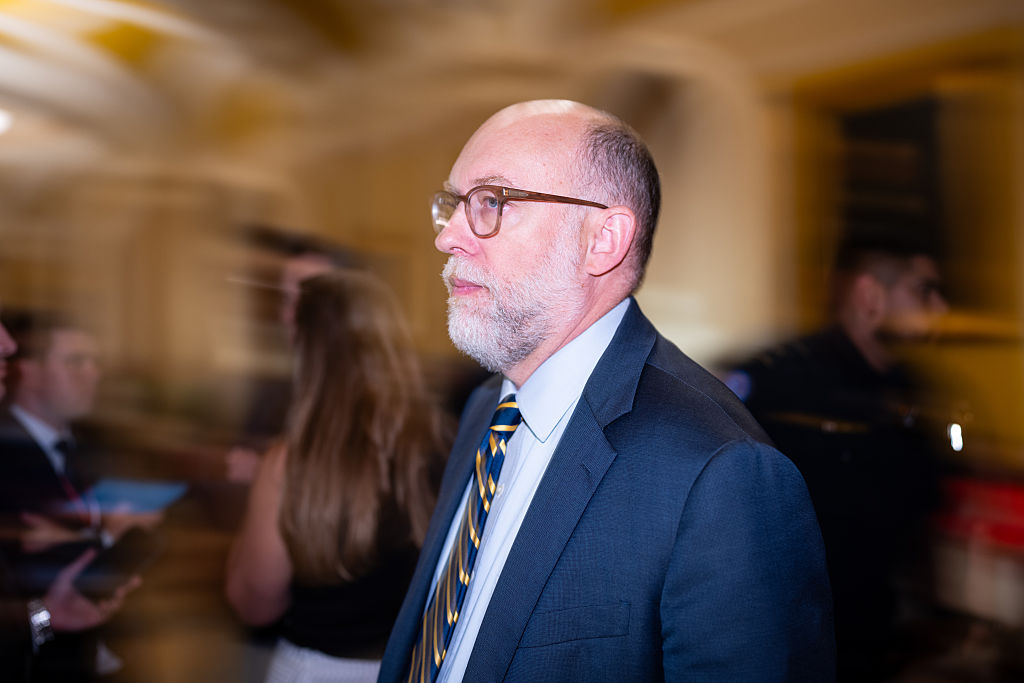
On Friday, The Washington Post reported on a contentious White House meeting in which the director of the National Institutes of Health (NIH), Jay Bhattacharya, tried to fend off yet another effort to place funding decisions under political control. The move came from Russell Vought, head of the Office of Management and Budget (OMB), which has sought to limit and control research funds. The Post suggested that Bhattacharya ended up on the losing side of the fight.
This initial leak has been confirmed and expanded on by outlets such as The New York Times and Politico. It now appears that the administration is drafting an executive order that would give Vought veto power over every individual grant awarded by the NIH.
If at first you don’t succeed
The NIH is the largest funder of biomedical research on the planet, and its $47 billion budget is larger than that of the next 10 research funders combined. Its funding, distributed largely through grants to academic researchers at universities, supports everything from basic biological research to clinical trials and has helped the biotechnology industry flourish.
But Vought seems to feel that it has funded a lot of “woke” research. Immediately after Trump re-entered the Oval Office, the agency terminated a broad range of grants on topics like pandemic preparedness and health disparities and proposed a budget that would shrink the NIH by nearly half. That cut was rejected by Congress, and the policy behind the NIH grant terminations was also voided by a court. Vought responded to these setbacks by proposing new grant funding rules that would make political considerations key determinants in which grants get funded. Congress put that rule on hold, too.
Apparently dissatisfied with simply blocking funding for entire fields of research and frustrated by Congress, Vought decided to have another go at the NIH’s grants. According to the Politico report, he leveraged one of Trump’s weaknesses: a desire to harm Harvard University. Early in his second term, Trump suspended all grant funding to a number of universities, seeking large payments from them in exchange for restoring the funding and dropping investigations. Harvard declined to go along and eventually won a lawsuit that restored the funding. But when news reports suggested that Harvard had agreed to a settlement without a payoff, Trump immediately demanded $1 billion from Harvard as part of any settlement.
In the White House meeting, Vought reportedly presented OMB control of NIH grants as an alternate means of targeting Harvard. Bhattacharya, to his credit, objected.
Impractical and potentially illegal
That objection was not a foregone conclusion. Bhattacharya remains upset that his ideas regarding the COVID pandemic—let it spread largely unchecked—were sidelined, and he has treated his NIH post as an opportunity to right perceived wrongs. In addition to terminating funding to a wide range of politically sensitive research, Bhattacharya has also underplayed the blatantly unscientific and dangerous ideas of his boss, Secretary of Health and Human Services Robert F. Kennedy, Jr. So there were plenty of reasons to think that he might be equally willing to go along with Vought’s ideas.
But he appears to have lost, so all NIH grants will now be subject to approval by a committee that includes both Vought and Bhattacharya. Unless that committee agrees unanimously that the grant should go forward, the funding will be rejected.
It’s not at all clear how this will work in a practical sense. During the Biden administration, the NIH funded over 64,000 grants a year. As heads of their respective agencies, Vought and Bhattacharya presumably have other duties and would be hard-pressed to give each proposal a serious evaluation. The committee would also presumably act only after funding decisions have been made. In the absence of a system for shifting the funding to other grants, though, this runs the risk of leaving the NIH unable to spend all the money Congress allocates to it (which may well be Vought’s intention).
In the past, the NIH determined funding by ordering grants based on scientific merit scores assigned by expert peer reviewers. That system provides an obvious way to shift money from rejected grants to the highest-quality unfunded proposals. But Vought has also been attempting to limit the use of peer review in evaluating grants, making it unclear if such a system would still be viable.
Ultimately, this move will almost certainly be rejected by the courts, as it clearly fits the key standard for illegal administrative actions: arbitrary and capricious. It solves no problems, it’s not required by any law, and it’s difficult to imagine any legal justification for it. “Vought wants to stop the NIH from spending its budget” is not a legal justification.
But for the policy to reach the courts, someone will have to first have to prove that they are sufficiently harmed to have standing to sue. As with so many other administration actions, that means the pending executive order could do a lot of damage before the courts can intervene.