Curiosity Rover Celebrates Its 5,000th Day on Mars With Panorama of Sandy Ridge
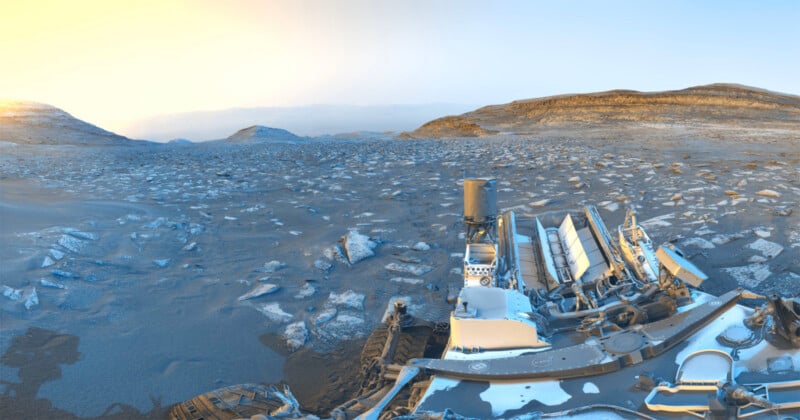
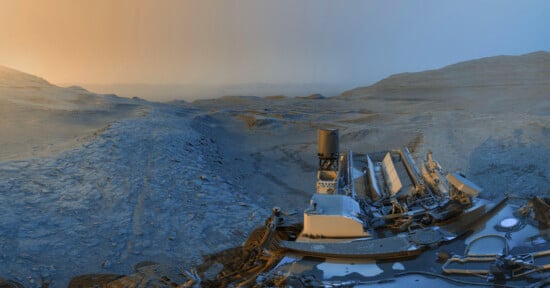
NASA’s Curiosity rover has marked 5,000 Martian days on the Red Planet with a new panorama captured from a sandy ridge known as “Chocolatal.”
The rover used its black-and-white navigation cameras to photograph the landscape at two different times. The first image was taken on August 30, 2026, at 9:56 A.M. local Mars time, corresponding to Curiosity’s 5,000th sol. A second panorama was captured on September 2 at 5:39 P.M., during the rover’s 5,003rd sol.
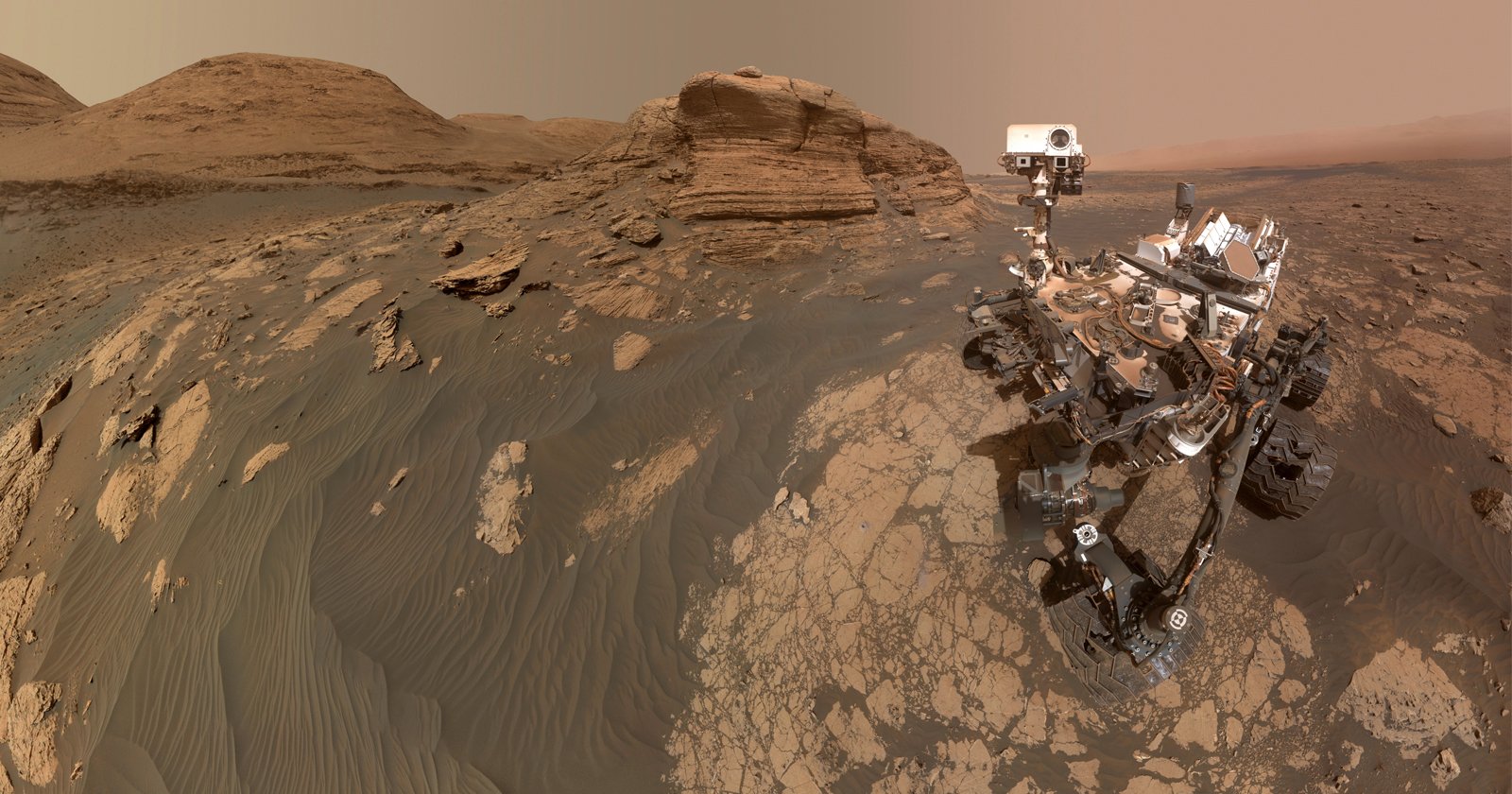
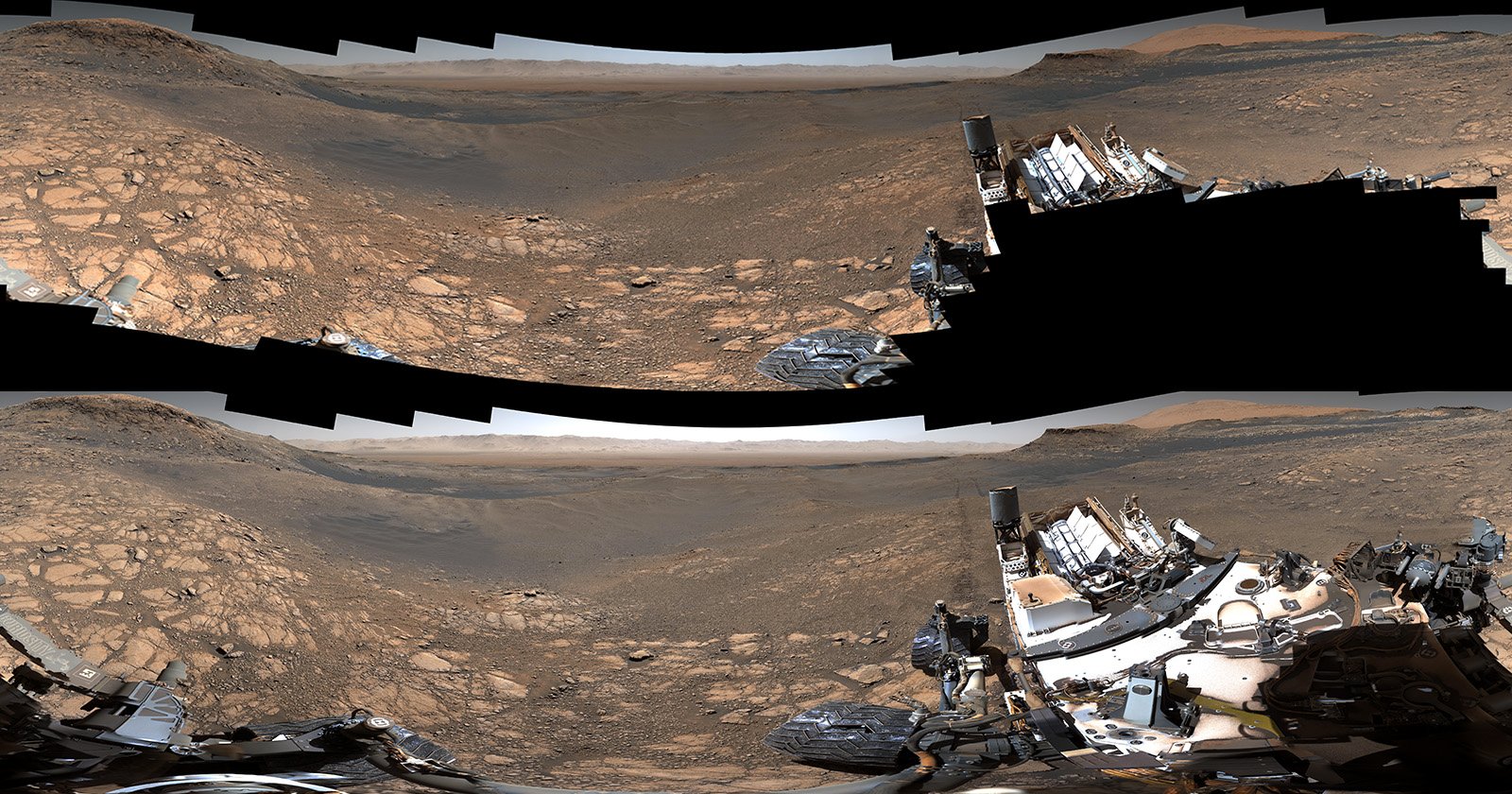
The two panoramas were transmitted to Earth and combined into a single scene. Color was added as an artistic interpretation, with blue representing the morning image and yellow representing the afternoon view. The resulting image has the appearance of a postcard, similar to other Curiosity panoramas produced in the past, including one last December.
The Curiosity rover occupies the foreground, with several components visible. SciTechDaily notes that among the visible instruments is the can-shaped UHF antenna, which is used to transmit data to spacecraft orbiting Mars. The finned Multi-Mission Radioisotope Thermoelectric Generator, or MMRTG, can also be seen at the rear. The nuclear power system provides Curiosity with the energy needed to operate on the Martian surface.
The rover’s wheel tracks stretch away behind it across the terrain, providing a visible record of its route through Gale Crater.
Curiosity is currently exploring the lower foothills of Mount Sharp, a mountain that rises about three miles (5 kilometers) within Gale Crater. The new panorama looks downhill toward the crater floor, while the distant crater rim is only faintly visible along the horizon.
The Curiosity rover has been productive during its 5,000 sols on Mars (a sol is roughly 40 minutes longer than an Earth day). It regularly picks out interesting objects to photograph, such as last month when it captured what looked like footprints on the Red Planet. NASA explained that the unusual features are broad, shallow pits on the bedrock.
Curiosity was built by NASA’s Jet Propulsion Laboratory, which is managed by Caltech in Pasadena, California. JPL leads the mission for NASA’s Science Mission Directorate in Washington as part of NASA’s Mars Exploration Program portfolio.
Image creditsNASA/JPL-Caltech
Affiliate Disclosure PetaPixel articles may include affiliate links; we may earn a commission if you buy through one.