a change in the rankings
AI disqualification yields new Nikon Small World in Motion winner
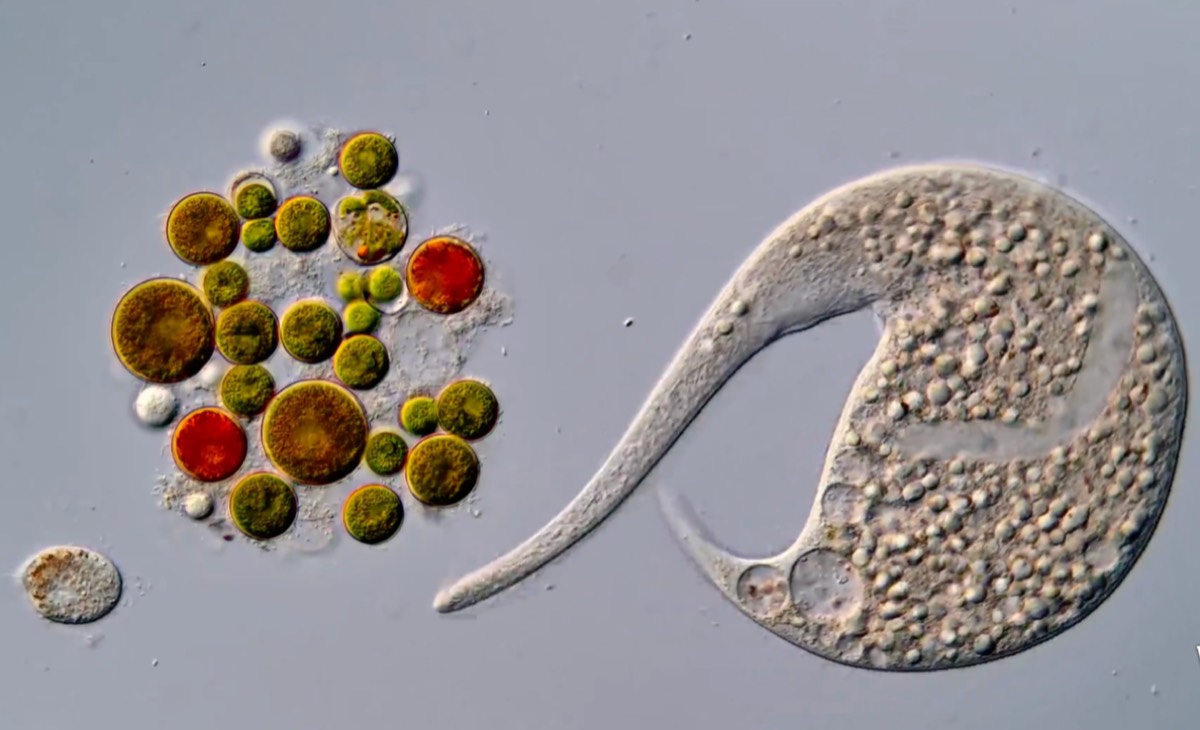
New winner is Nguyen Nam Nhat of Vietnam for video of a roundworm and single-celled Dileptus.
Credit:
Nguyen Nam Nhat
Credit:
Nguyen Nam Nhat
Last month we covered the winner of Nikon’s Small World in Motion video: Ning Xu of Tsinghua University in China, whose video captured tiny cilia beating in the airways of a child with a rare respiratory disorder. But allegations surfaced about Xu’s use of AI while making the video. Nikon launched an investigation and concluded that Xu’s entry did not comply with competition rules. The new winner is Nguyen Nam Nhat of Vietnam with a video of a tiny roundworm and a single-celled organism (above).
According to a BBC report, some researchers expressed concern that Xu’s video had structural abnormalities and that cell features appeared and disappeared in a way one would not see in actual cellular biology. Others spotted what looked like AI watermarks embedded within the source files. Xu said he used AI “to distinguish and visualize features in the reconstructed grayscale images”; however, he denied that AI was used “to generate the experimental movie, the cilia, or their motion.”
Founded in 2011, the Nikon Small World in Motion competition is a spinoff of the company’s Small World Photomicrography Competition, which has been around since 1974. Both are meant “to showcase the beauty and complexity of things seen through the light microscope”—one through still photographs, the other through photovideography, taking advantage of all the technological advances that now allow users to make movies or time-lapse images through the microscope.
The other winners also moved up a notch with Xu’s disqualification. Benedikt Pleyer of Bavaria, Germany, placed second with a video of jellyfish larvae suspended in water droplets; Andrew Moore of Howard Hughes Medical Institute in the US placed third with a video of synchronized cell division in neighboring cells; Patrick Hickey of Hypha Research Ltd. in Edinburgh, Scotland, placed fourth with a video of the dynamics of mitochondria and chloroplasts in Turtle Vine leaf cells; and Igor Adameyko placed fifth with a video of a tiny, colorful sea slug (Cyerce kikutarobabai) on the move.
Here is Nikon’s full statement:
After thoroughly re-evaluating the video and supporting materials and consulting with members of our judging panel, Nikon has determined that the winning video did not comply with the competition rules regarding generative AI. Nikon has adjusted the competition rankings on our website to reflect this decision.
This decision is based solely on the submitted video’s eligibility under the rules outlined for this competition. It should not be interpreted as a judgment of the entrant’s professional reputation, scientific contributions, or intent.
Advances in imaging and artificial intelligence continue to evolve rapidly, creating new challenges for organizations across many fields. This event has shown the need for Nikon Small World and Nikon Small World in Motion to revisit rules and evaluation procedures for future competition entries.
The Nikon Small World and Nikon Small World in Motion competitions celebrate excellence in imaging, both scientific and artistic in nature. We value the integrity of each image and video selected to appear in our winning galleries, and remain committed to upholding the standards of excellence that have defined this competition.