Troubled waters
The Internet’s undersea backbone is slipping into the danger zone
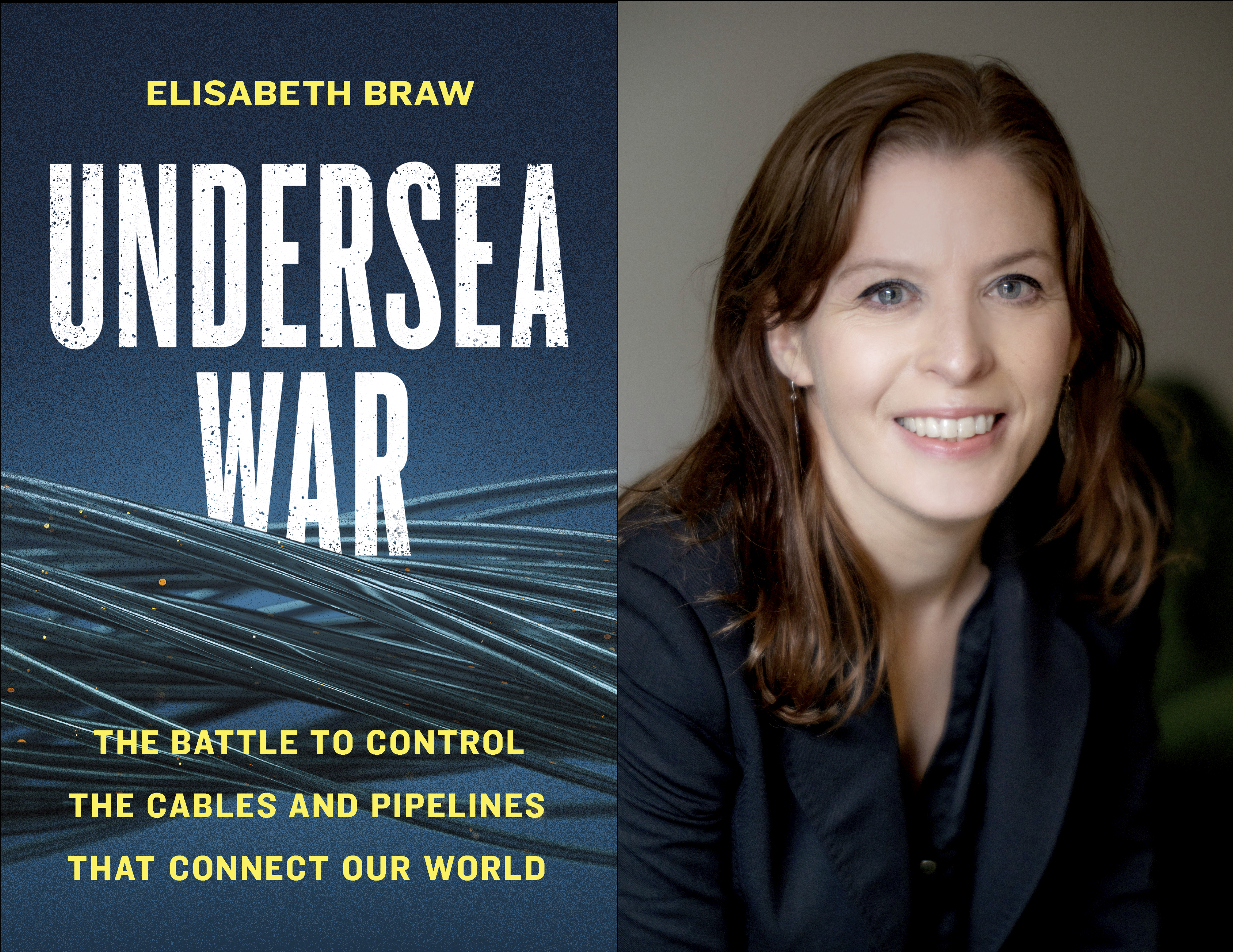
Elisabeth Braw’s book Undersea War on rising risks for undersea infrastructure.
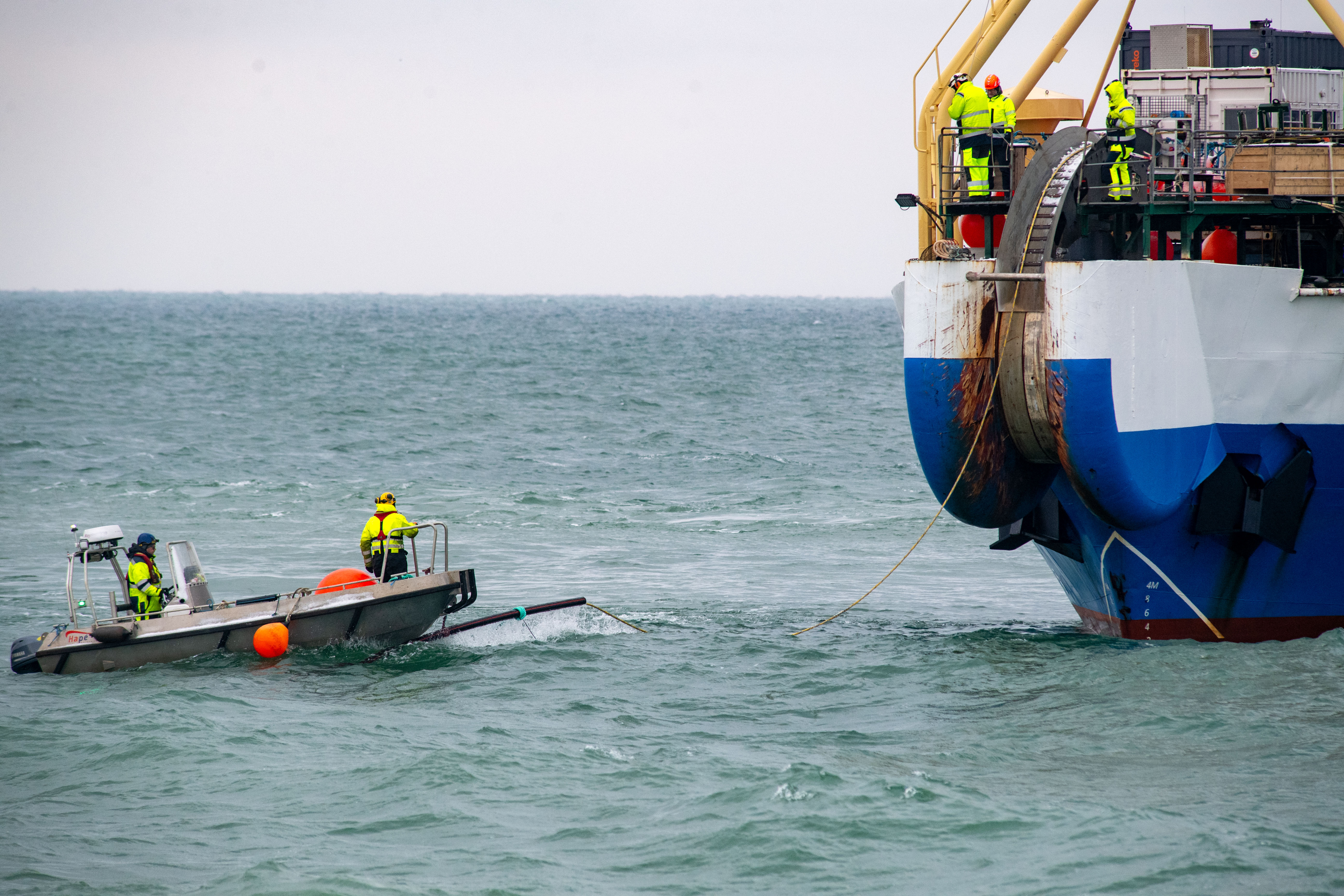
Despite the expansion of Starlink and other communications satellite services, most of the world’s Internet traffic still travels through subsea cables crisscrossing the ocean floors. Those fiber-optic cables coexist with a network of oil and gas pipelines and submarine power cables—and all these crucial links connecting countries and continents now face growing sabotage risks as gray-zone warfare and open conflicts have become widespread.
The rising risks to the world’s invisible infrastructure beneath the waves are the main subject of a new book by Elisabeth Braw, a senior fellow at the Atlantic Council who leads the Threats to the Global Maritime Order Initiative. Her book, titled Undersea War, explores the modern rise in suspicious incidents in which ships dragging their anchors for unusually long periods have cut or damaged undersea cables and pipelines from the Baltic Sea to the Pacific Ocean.
Braw acknowledges that about 60 percent of undersea cable damage is primarily due to human error during fishing and shipping activities, when weighted nets or anchors drag across the seabed. Natural hazards such as storms and undersea landslides also account for a smaller proportion of such incidents. In total, between 150 and 200 cables are damaged each year and usually repaired quickly.
But international tension between superpowers and open war in Europe and the Middle East have led to increased scrutiny of cable-cutting incidents, with governments investigating and sometimes prosecuting crews for allegedly causing deliberate damage to subsea cables. One of the more notorious incidents documented in the book is the “Christmas Day massacre” of 2024, when a Russian-linked oil tanker named Eagle S dragged its anchor across the seabed for about 56 miles (90 kilometers), cutting or damaging four data cables and the Estlink 2 submarine power cable connecting the Baltic and Nordic power grids.
One of those data cables had also previously been severed by the Chinese cargo ship Yi Peng 3 just one month earlier in November 2024, when that ship damaged two data cables in the Baltic region. That ship’s crew was not prosecuted by European authorities, whereas the Finnish government has attempted to prosecute three senior officers of the Eagle S.
On the other side of the world, the captain of the Chinese-owned ship Hong Tai was convicted by a court in Taiwan of severing an undersea telecommunications cable in February 2025 and sentenced to three years in prison in June 2025. The island democracy’s legislature later amended its laws to increase penalties for intentional damage to undersea cables or pipelines and allow for up to seven years in prison.
This year has seen several notable incidents involving both overt and covert threats to undersea infrastructure, including Iranian efforts to impose fees on operators of undersea cables running through the contested Strait of Hormuz. Separately, a joint operation involving the UK, Norway and the United States confronted Russian submarines that were practicing using a new technology to disable undersea cables in Arctic waters near Norway’s Svalbard archipelago.
What happens when the Internet’s undersea backbone, not to mention crucial energy infrastructure, is no longer protected by near-universal international agreement? Ars spoke with Braw to find out more. (The interview has been condensed and edited for clarity.)
Hachette Book Group (cover art) / Annabel Moeller (author photo)
Credit:
Hachette Book Group (cover art) / Annabel Moeller (author photo)
Ars Technica: Right now there’s so much suspicion and tension around undersea infrastructure. But it does seem like for quite a few decades, even during the Cold War, there was a broad international framework that mostly worked where countries generally agreed not to mess around too much.
Braw: Exactly. It worked for so long, and that’s why it’s so frightening to see that system that really depends on everybody doing the right thing and being a good seabed citizen, as it were, may not work for that much longer.
Ars Technica: I know it’s not really any single factor, but I’m curious what you would highlight as the key contributing factors to why we’re seeing a breakdown in that general agreement.
Braw: If you think about the absolutely crucial nature of subsea cables and pipelines, especially subsea cables… if they were to be disrupted for even just a minute, it would cause massive disruption to not just the New York City area, but also New York as a financial hub. It would cause operational losses, but also the loss of all that money that goes through the cables every second of every day.
So if you think about the utter importance of subsea cables to modern societies and modern economies, then that makes them incredibly attractive as a target. Whereas during the Cold War, we had telephone cables, but there weren’t that many of them, and we didn’t use them as much. Yes, they were used for international phone calls, and there were also telegraph messages that could be sent. But nobody sent telegrams around the clock, and nobody made international phone calls around the clock. So they were there, but they were just less crucial.
Also, despite it being a Cold War and a very dangerous few decades, there was some sort of agreement that when you sign a treaty, you uphold it. In fact, the United Nations Convention on the Law of the Sea was adopted in 1982 during the height of the Cold War. So there was a commitment to creating some sort of rules of the road.
Today that commitment is, I don’t want to say it’s vanishing, but it’s declining among key countries in the world. And at the same time, we are seeing Russia has discovered that it’s really quite beneficial to use non-military means to weaken other countries, and this is something that Russia has come to specialize in, and other countries may yet come to specialize in. That makes the cables around the seabed highly attractive as a target.
Ars Technica: There was even recent reporting on how NATO countries apparently foiled a Russian attempt to practice undersea cable sabotage, although that incident took place back in the spring.
Braw: The fascinating thing about subsea cables and pipelines, but especially subsea cables, is not just that we are utterly dependent on them. They don’t sit only within countries’ territorial waters. They connect countries, so they are in international waters [where] countries don’t have jurisdiction. The oceans are a global commons, and that’s where cables live, and that’s why it’s so utterly important for countries and everybody using the oceans to take care around them so that they don’t get damaged.
Then what we have seen in the past few years is that, all of a sudden, merchant vessels in the Baltic Sea and off the coast of Norway and in Taiwanese waters, all of a sudden, they got extremely sloppy and dragged anchors for long stretches, which is something that is not supposed to happen as a seafarer. You should know whether your anchor is dragging on the seabed or not, and you know where the cables are.
So this is not supposed to happen, and yet it happened not just once, not just twice, but several times, and caused considerable anxiety, obviously, in the countries affected. It also caused considerable expenses to the operators because they have to get the cables repaired, and in the case of the electricity cables, it’s extremely expensive to repair them and takes a very long time.
We don’t know what has caused these merchant vessels to drag their anchors across the border sea and damage cables, and we may never know because it’s not like those crew members are going to tell us what happened. We just know that these incidents were extremely suspicious.
But then we have what you just brought up, that Russia and other countries may develop tools to damage other countries’ subsea cables using submarines or gadgets or drones attached to submarines, and that’s where we are today. That might yet happen, and that’s why it’s always so concerning when Russian research vessels loiter around subsea cables. What are they doing there? What is it that they are looking at? What is it they are measuring?
China does the same thing. It sends research vessels that loiter in other countries’ waters for long periods of time. And you’re supposed to inform the country in whose waters you are conducting research that you are conducting research and what the nature of your research is, but China doesn’t do that. So what is it that these research vessels are doing? What is it they are researching?
This is all in the context of increasing geopolitical tension, and by the way, also rapid expansion of submarine fleets: Western ones and the Russian one and the Chinese one. But also the expansion of other undersea equipment, gadgets, drones, and so forth.
Ars Technica: Another point your book touched on was everything that’s been happening around the Strait of Hormuz, and how we have seen Iran either threaten to put a fee on companies that want to run undersea cables through there, or threaten to attack them. At the same time, it sounds like a number of companies have rethought undersea cable projects that were intended to run through that region.
Braw: This is another fascinating aspect of the situation for subsea cables. So in the Persian Gulf, in the Strait of Hormuz, there are subsea cables, and they are indispensable not just for the countries connected by them, but also for other nearby countries. For example, one third of India’s westbound Internet traffic or digital connectivity goes through the Persian Gulf. So it just illustrates how important these cables are, and not just to countries that are immediately connected.
In February of this year, the situation was that three cable projects were about to be launched or were being conducted. Then the war began, and you can imagine that when missiles are flying, drones are flying around, it’s impossible to install cables on the seabed. Because if you think about ships, that is dangerous enough, but ships are moving. Installation ships are stationary. You really are like a sitting duck, and so those projects had to be suspended or abandoned and the companies declared force majeure.
But we need subsea cables. So what will happen as the world becomes more contentious, as there are more conflicts, or as more conflicts erupt? How are cable installation crews and cable repair crews supposed to do their work when there are various projectiles and other weapons flying around them or next to them on the ocean? This is where geopolitics is truly clashing with modern economies, and at the front line are cable installation crews and repair crews.
And then you asked about the toll that Iran said it was going to impose. This was a new and, I have to say, unsurprising twist on the Iran war. So everybody has heard about the fact that, a few weeks into the war, Iran said it was going to charge tolls on shipping in the Strait of Hormuz, and that is a violation of UNCLOS, the United Nations Convention on the Law of the Sea. Iran said it was going to do that anyway, and Iran could claim that it didn’t need to uphold UNCLOS, which it has signed but not ratified. But until February, it had upheld UNCLOS, and shipping had worked well in the Strait of Hormuz.
Then in March, Iran could say that it wasn’t bound by UNCLOS anymore because the US and Israel had violated the UN Charter by attacking it. So why should it uphold UNCLOS? And this is the dangerous situation we’re in, where countries can say, “Well, why should I uphold my treaty obligations when such and such country isn’t upholding that?”
So what Iran said a few months into the war—after having imposed tolls on shipping for a while—was that it was going to charge tolls on the subsea cables in the Strait of Hormuz. And yes, it is a violation of UNCLOS. But it could say, “Well, the US has violated the UN Charter, so we get to do as we like too.”
If you think about the implications of that, it’s not just implications for cable operators in the Strait of Hormuz. How would they make payments to Iran? How would that work? And if they don’t make payments, what would happen? But it’s also a question for other cable owners. What if other countries say, “Well, there are cables in our water, so we are going to charge a toll because countries aren’t adhering to UNCLOS anyway, so we might as well.”
It’s not just that you know the world was harmonious, and all of a sudden there were some suspicious cable incidents. It is that the order on the ocean—and even on land too—is deteriorating, and in the midst of all that we are experiencing suspicious cable incidents.
Ars Technica: These undersea cables are obviously of great national interest to governments and may require even military protection in some cases. But at the same time they’re being developed by private operators, including a lot of tech giants. We just saw Meta announcing it was going to lay the first petabit capacity cable across the Atlantic, and that’s part of a much broader buildout of undersea cables. What does this private ownership but public interest collision mean for who takes responsibility, especially as there are increasing threats?
Braw: It’s such an important question. Ever since the first cables were laid on the seabed, they have been privately owned. The cables that then joined them were also privately owned. Then, in the 1900s, postal services in different countries took over the operation of cables. So many cables were state-owned.
Then later in the 1900s, we started seeing more privately owned cables again. And today, virtually all cables are privately owned, typically by consortia. But shorter cables are often owned by one company. And a crucial development is what you also mentioned, that the hyperscalers are building their own cables for their own traffic. So, these are private operators, but [the cables are] critical national infrastructure. And what governments want may be different; in fact, it is different from what operators want.
So people often ask me, “Shouldn’t operators install more cables to make sure that they always have cables that are operational?” And yes, you can say they should, but each cable is an expense in the installation and the operation of the cable. Companies will look at figures and the hard facts, and are likely to conclude in many cases that the risk of their cables being damaged in some malicious way is smaller than the expense of adding more cables, and that’s a commercial calculation, right? Whereas for national governments, it would clearly be in their interest and they would want to see more redundancy. But they don’t own the cables, and commercial operators exist to make money.
The only other alternative is for governments to subsidize new cables. And I write about this in the book as well, what happened with the Matsu Islands [governed by Taiwan]. But we don’t have that sort of money to create backups for every cable on the seabed. So this is the clash, as it were, the interests of cable owners and the interests of national governments.
Ars Technica: It was interesting to see how that first cable, when it was laid, was used to send a message of hope and peace. And then there were also newspapers declaring that having this near-instant communication across the oceans would basically usher in an era of world peace. So again, viewing this technology as finally bringing about world peace when clearly it hasn’t done that.
Braw: One can hope.