Google grooves with AI
Singer or clanker? YouTube Music will tell you with new gen AI labeling.
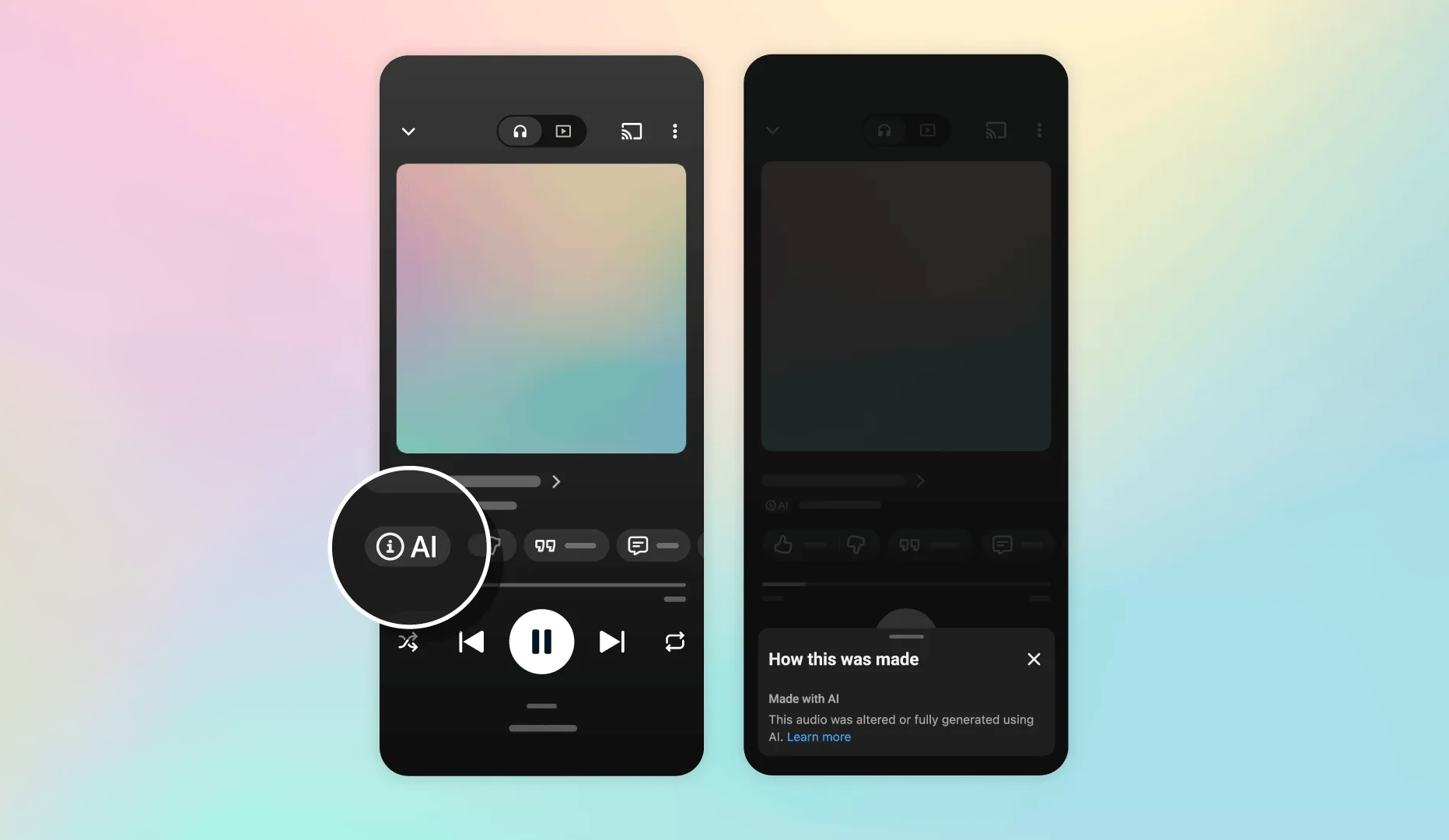
The AI music labels are rolling out now in YouTube Music and will come to YouTube soon.
Credit:
Credit:
Genuine human creativity takes time, but you know what doesn’t? AI slop. There are countless AI models out there that can make something that passes for music, and you might come across those tracks on streaming services without realizing it. Google says it will begin labeling that content in YouTube Music, building on similar disclosures in the main YouTube app.
Google is not outright banning AI music or even speaking ill of it. “Generative AI is opening up new ways for artists to create, experiment, and share music,” the company says in a blog post.
However, the company also acknowledges that people want to know if a song was created with generative AI tools. A new label for AI content on YouTube Music is now rolling out in the app and on the website, which looks a lot like a label Google began adding to AI-generated videos on YouTube earlier this year.
The AI label will be visible on the player page, and a tap will open a menu with more information. The label will be applied to songs that were created entirely or altered significantly with AI. But how will Google know when to apply that label? That could be a little tricky.
The process of labeling AI music will be similar to Google’s detection setup with YouTube videos. Google says it is working with partners and using its own detection tools to identify AI music. When publishers upload content, they can specify how much (if any) gen AI was used. The tiers are fully gen AI, partially gen AI, and no gen AI. However, this is optional.
YouTube may also be able to detect AI usage without voluntary disclosure. In the case of tracks created using Google AI, there’s SynthID watermarking to indicate whether something was generated or edited with AI. It may also use C2PA metadata, which many other AI musicmakers use.
While Google is in a better position than most streaming services to spot AI content, the absence of a label should not be taken as proof that something is the product of human talent. This is true with AI labeling of all types of content. There are just too many ways to utilize AI tools, many of which leave no identifying mark in the resulting file.
Labeling AI tracks is a step in the right direction, but it may not be as useful as it is on YouTube videos. On YouTube, you’re probably looking at the screen and will see the AI label, but that is often not the case when listening to music. You’ll have to suspect something is amiss and check your phone or background tab to find out if what you’re hearing is AI-generated. There is no option to simply block labeled AI tracks from appearing in your playlists.
AI labeling for music is rolling out now in YouTube Music. Google notes that AI music uploaded as YouTube videos will get the same treatment soon.