Strikes from sea to shining sea
Ukraine sinks Russian warship, strikes cargo ships from Mediterranean to Baltic
Russian missile corvette latest casualty as Ukraine strikes back in war at sea.
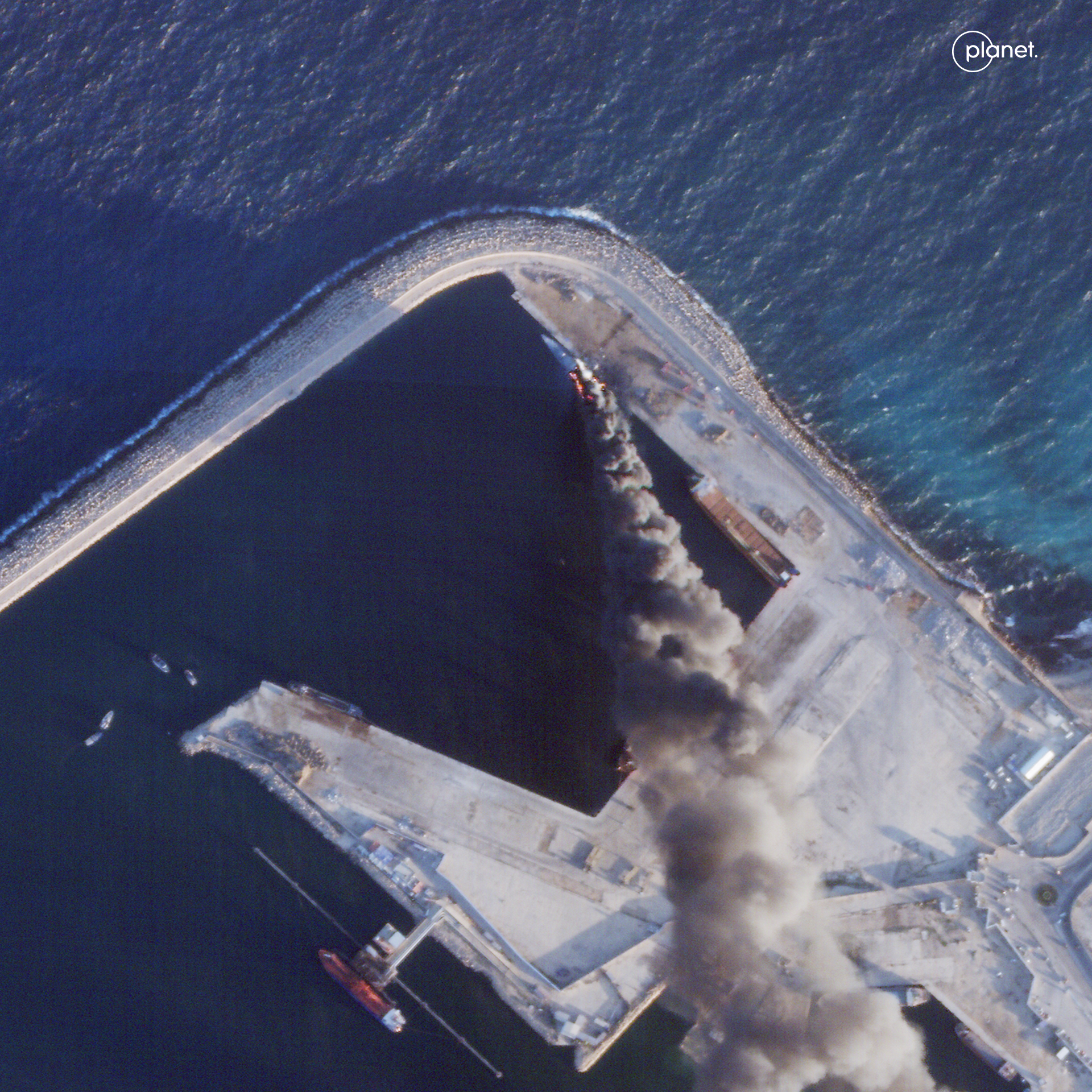
Ukrainian explosive naval drones sank a Russian warship docked in the port city of Benghazi in Libya while also striking a Russian cargo ship that it was escorting. The incident demonstrates the expanding scope of Ukrainian military strikes on Russian ships from the coast of North Africa to the Gulf of Finland.
The Russian Navy’s missile corvette Merkury sank at port after being struck by at least two Ukrainian naval drones on November 22, according to the Associated Press. Ukraine’s Security Service described using seven naval drones launched from a mother ship to target the Merkury, and Ukrainian President Volodymyr Zelenskyy shared video footage showing the drone boats approaching and exploding against both the burning Russian warship and a Russian dry cargo ship, MV Angara.
Zelenskyy noted that a Ka-27 combat helicopter onboard the Merkury was also destroyed. He described the cargo ship MV Angara as transporting weapons—Russia provides material support to the Libyan National Army that currently controls Benghazi and is battling the internationally recognized Libyan government based in Tripoli.
Casualties from the strikes included at least 10 people, including Libyan and Russian nationals, Libyan National Army officials told the Associated Press. They also mentioned some wounded crew members of the Russian warship being transferred to local hospitals.
Merkury was a Steregushchiy-class missile corvette, designated by Russia as Project 20380, that can carry both anti-ship and air-defense missiles. They are also armed with torpedoes to counter submarines and have a naval cannon mounted on the deck.
Corvette-class warships are typically smaller than the destroyers or frigates that often act as workhorses of modern navies, although NATO has designated Russian missile corvettes such as the Merkury as being equivalent to frigates.
Merkury was originally meant to join Russia’s Black Sea Fleet. But after Russia launched its full-scale invasion of Ukraine in 2022, the Russian warship was unable to enter the Black Sea because Turkey invoked the 1936 Montreux Convention to restrict warships from entering or leaving the Black Sea. Instead, the Merkury mainly operated from Russia’s Northern Fleet bases in Arctic waters, according to the naval analyst HI Sutton.
Battle for the Black Sea
The sinking of the Merkury marks the latest significant setback for the Russian Navy, which nominally remains one of the world’s leading navies in terms of number of ships and capability. The attack also shows Ukraine’s expanding geographical deployment of sea drones, which resemble low-profile drone boats that can be armed with machine guns, missiles, and explosives when engaged in kamikaze ramming missions.
Ukraine has used such drone boats in combination with flying drones and missiles to challenge the Russian Navy’s control of the Black Sea and Sea of Azov, which hold crucial shipping lanes for both countries and represent staging grounds for military operations. Ukraine has struck Russian warships at sea and in port, including another Russian missile corvette named the Boikiy that was seriously damaged by Ukrainian aerial drones while docked in St. Petersburg in June, according to Naval News.
Ukraine’s contestation of the Black Sea also undermines Russian efforts to maintain control of the Crimean Peninsula, which Russian forces seized from Ukraine in 2014. For example, Ukrainian aerial drone strikes on dozens of Russian-linked tankers and cargo ships in the Sea of Azov in July 2026 forced Russia to severely restrict resupply runs by sea.
Throughout 2026, Ukraine has also steadily increased its mid-range drone strike campaign targeting Russian roads and railways along the limited land-based supply corridors connecting Russia to Crimea.
On the nights of November 15 and November 16, waves of Ukrainian drones and missiles succeeded in collapsing one of two steel arches supporting the Kerch Strait Bridge—a structure built by Russian President Vladimir Putin’s regime as both a symbolic and physical link between Russia and Crimea.
That has left only the bridge’s railway still functional as a supply link for Russian-occupied Crimea, although Ukraine has continued targeting the remaining structure. Fallen debris from the bridge’s steel arch and roadway has also blocked the only deep-water route that allowed ships to pass through the Kerch Strait between the Sea of Azov and Black Sea.
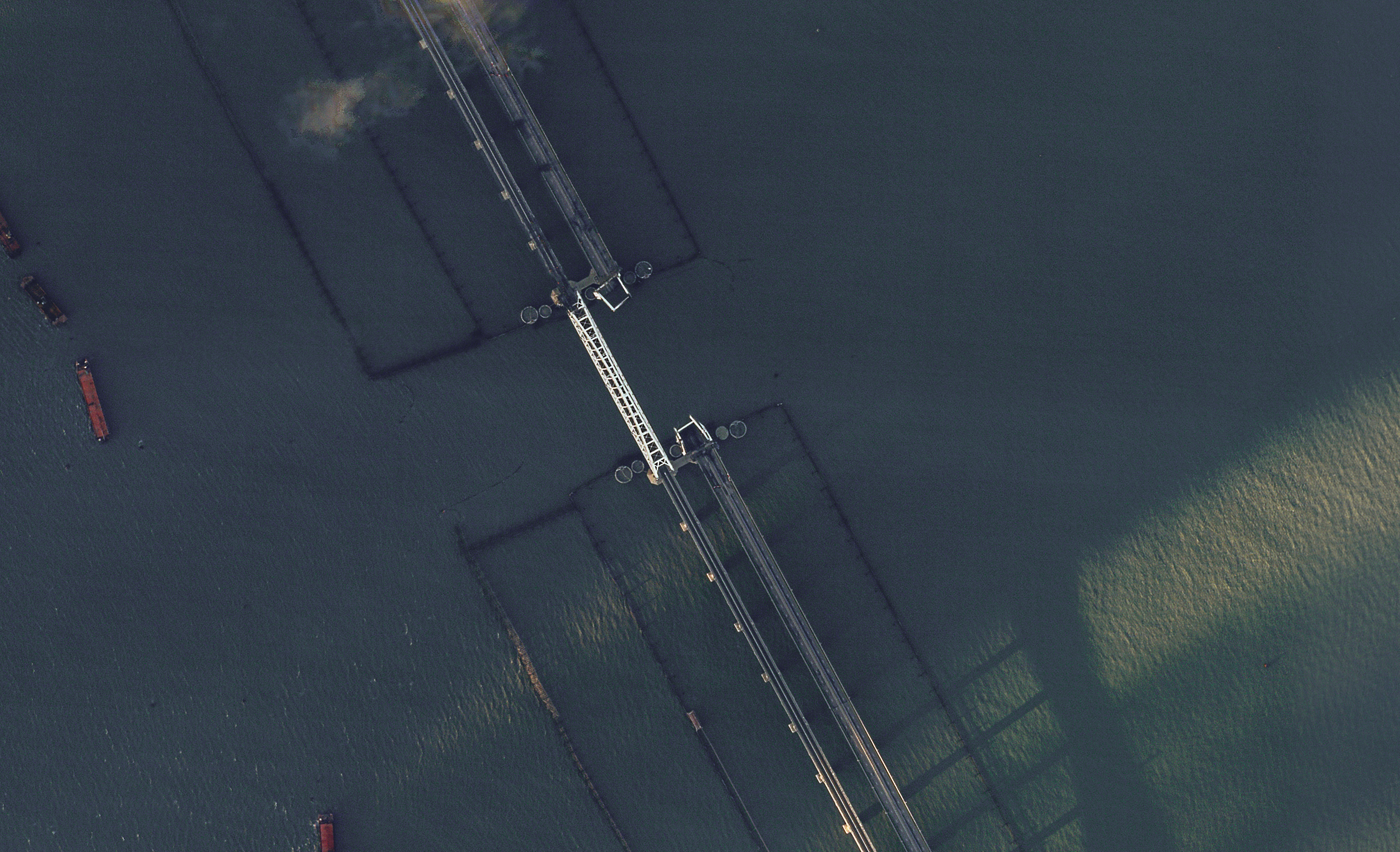
Planet Labs PBC
But Russia has struck back with its own drone and missile strikes on Ukrainian ports and third-party ships traveling to and from Ukrainian ports. Starting in October, Russian aerial and sea drones also began striking and sinking commercial shipping near the coasts of NATO member countries Bulgaria and Romania.
Widening war at sea
Meanwhile, Ukraine has increasingly taken the fight against Russia beyond the Black Sea. Ukraine’s sinking of the Merkury and strike on the MV Angara are only the latest examples of such strikes in the Mediterranean Sea.
The most notable previous example involved the liquefied natural gas tanker Arctic Metagaz—a shadow fleet ship sanctioned for carrying Russian oil—that was wrecked by massive explosions while heading for Benghazi on March 3. Russia described the ship as having been struck by Ukrainian sea drones in the Mediterranean, although Ukraine did not publicly take credit for the attack, according to The Guardian.
More recently, Ukraine has also expanded its drone strikes northward to Russian-linked ships in the Gulf of Finland within the Baltic Sea. On November 11, Finnish authorities confirmed a strike on a Russian Navy Buyan-M class corvette named Naro-Fominsk, with Ukraine’s Security Service later claiming credit, according to BBC News. The damaged warship headed back to the Russian port of St. Petersburg.
That incident was followed by at least two drone strikes on the Russian dry cargo ship Sparta II in the Gulf of Finland on November 21, according to ERR News. The Sparta II is sanctioned by the United States and described by Ukraine as a Russian ship that has carried weapons and military equipment in the past.
Finnish authorities coordinated the rescue and response effort that also included Russian and Estonian ships, with the Sparta II eventually being towed by a Russian ship back to St. Petersburg, Reuters reported. But in a social media post, Finnish Prime Minister Petteri Orpo also described the situation as follows: “Ukraine has the right to fight back against the aggressor.”