Self-own
Could China and Russia really destroy Starlink? Only with a boomerang.
“We will likely have similar concerns and discussions when China fields its Starlink-like constellation.”

Credit:
SpaceX
Credit:
SpaceX
One week ago, three widely respected European news outlets published the results of an investigation into what they described as a “joint plan” by China and Russia to “defeat Elon Musk’s Starlink.”
The story was the product of a long-running inquiry by The Insider, Der Spiegel, and Le Monde. Reporters at those publications said they reviewed a cache of documents detailing growing military cooperation between China and Russia. The documents covered discussions between the nuclear powers on integrated air and missile defense systems, autonomous “swarm” loitering munitions, next-generation armored vehicles, and military aviation, the report said.
According to the papers, the investigation found evidence of a partnership between China and Russia in the field of space weapons far deeper than either country has acknowledged. One particular focus for China and Russia has been developing strategies to counter SpaceX’s Starlink satellite broadband network.
Among the documents the reporters reviewed were a series of slideshows presented at a previously undisclosed China-Russia Military-Technical Cooperation Forum held in 2023. The bilateral meetings have continued since then, with a sixth gathering on tap for the end of this year in St. Petersburg, the reporters said.
“The documents show a partnership that has moved well beyond shared rhetoric into a structured, multi-disciplinary program to build weapons neither country could develop alone,” the publications wrote.
Ars spoke with several former US defense officials and space security experts to assess the seriousness of China and Russia’s efforts to counter Starlink. First, is this a big surprise? Does the reporting make sense? And what does this mean for the ever-growing number of satellite constellations the US military relies upon for navigation, missile warning, communications, surveillance, and soon, tactical battlefield targeting?
Starlink has proven to be a vital advantage for the Ukrainian military since Russia’s full-scale invasion in 2022. In some cases, Starlink has helped Ukraine extend the effective reach of its weapons, taking the fight deep into the Russian heartland.
The US military, too, sees Starlink and its growing number of spinoffs as enablers for 21st century warfare. Starlink and its related constellations, like military-grade Starshield satellites, would likely give US forces an edge if the United States went to war with China or Russia today.
China and Russia are working on their own versions of Starlink, but neither is close to fielding anywhere near SpaceX’s current constellation of more than 10,000 satellites. This could soon change, at least for China, which recovered its first reusable orbital-class rocket booster following a launch earlier this month. Mastering rocket reuse will allow Chinese companies to ramp up their launch cadence, unlocking new capacity for deploying mega-constellations.

National Reconnaissance Office
Credit:
National Reconnaissance Office
Legitimate targets?
It’s no surprise, then, that China and Russia feel threatened by Starlink. The role of commercial satellites in warfare has sparked speculative discussions on their legitimacy as military targets, and what the Pentagon’s role should be in defending them. This theoretical debate is rapidly turning into reality.
A deputy director in Russia’s foreign ministry, Konstantin Vorontsov, said in 2022 that the use of Western commercial satellites by Ukraine established “an extremely dangerous trend.” While Vorontsov did not specifically name any satellites, he almost certainly was referring to SpaceX’s Starlink satellite constellation.
The use of civilian satellites for wartime purposes, Vorontsov said, essentially made them military targets. This was also the conclusion of Tara Brown, an officer in the Royal Air Force and a professor at the US Naval War College who specializes in space law. In a paper published by the Lieber Institute at West Point, which focuses on the study of the law of war, Brown wrote in 2022 that nations must be “cognizant of the risk of commercial satellite systems becoming valid military objectives.”
It’s not hard to understand Russian and Chinese motivations for degrading or destroying Starlink, one former senior US military space official told Ars.
“We and our allies will likely have similar concerns and discussions when China fields its Starlink-like constellation in the next few years, which certainly would have military applications,” the former official said. “Such capabilities are becoming more important, necessary, and critical to modern warfare.”
“China, in particular, has been concerned about Starlink for years, from an economic perspective as well as potential national security perspectives,” said Charles Galbreath, a retired Space Force colonel now serving as director and senior resident fellow for space studies at the Mitchell Institute for Aerospace Studies, a Washington, DC, area think tank.
“The collaboration between China and Russia on ways to counter it, that is more troubling than either one of them looking at it independently,” Galbreath told Ars.

Scott Peterson/Getty Images
Two employees of the China Aerospace Science and Technology Corporation (CASC) delivered a presentation at the 2023 Russo-Chinese military forum entirely devoted to countering Starlink. CASC is the state-owned enterprise that oversees China’s sprawling aerospace industry, directing the country’s development of launch vehicles and satellites.
Starlink would not be easy to defeat. The network is proliferated, with thousands of satellites interconnected using laser communications links and numerous ground stations to connect the constellation in low Earth orbit (LEO) with the terrestrial Internet. Destroying a handful of satellites or a single ground station wouldn’t put much of a dent in the network’s operational capacity. The CASC researchers argued this resilience is a threat, likening Starlink’s presence in low Earth orbit as a “blockade” squeezing out competition. This framing “lets the authors present an assault on the network as self-defense rather than aggression,” the publications wrote.
So, how might China and Russia go about countering Starlink? The Chinese team proposed three possible actions in an “escalation ladder,” starting with legal and diplomatic measures aimed at whipping up international pressure against further expansions of Starlink on the grounds of collision risks in LEO.
The next step is more technical, with coordinated filings with international regulatory bodies for frequency bands and orbital slots to limit SpaceX’s ability to grow Starlink. At the same time, the escalation ladder proposes using electromagnetic jamming of Starlink to block it in certain regions.
Finally, the coup de grâce would be the “physical destruction” of Starlink through a cyber war and anti-satellite weapons. Reporters at The Insider, Der Spiegel, and Le Monde suggested this might involve a cloud of high-density projectiles that could destroy Starlink satellites upon collision. The presentation by the Chinese CASC researchers didn’t specify the means of such an attack.
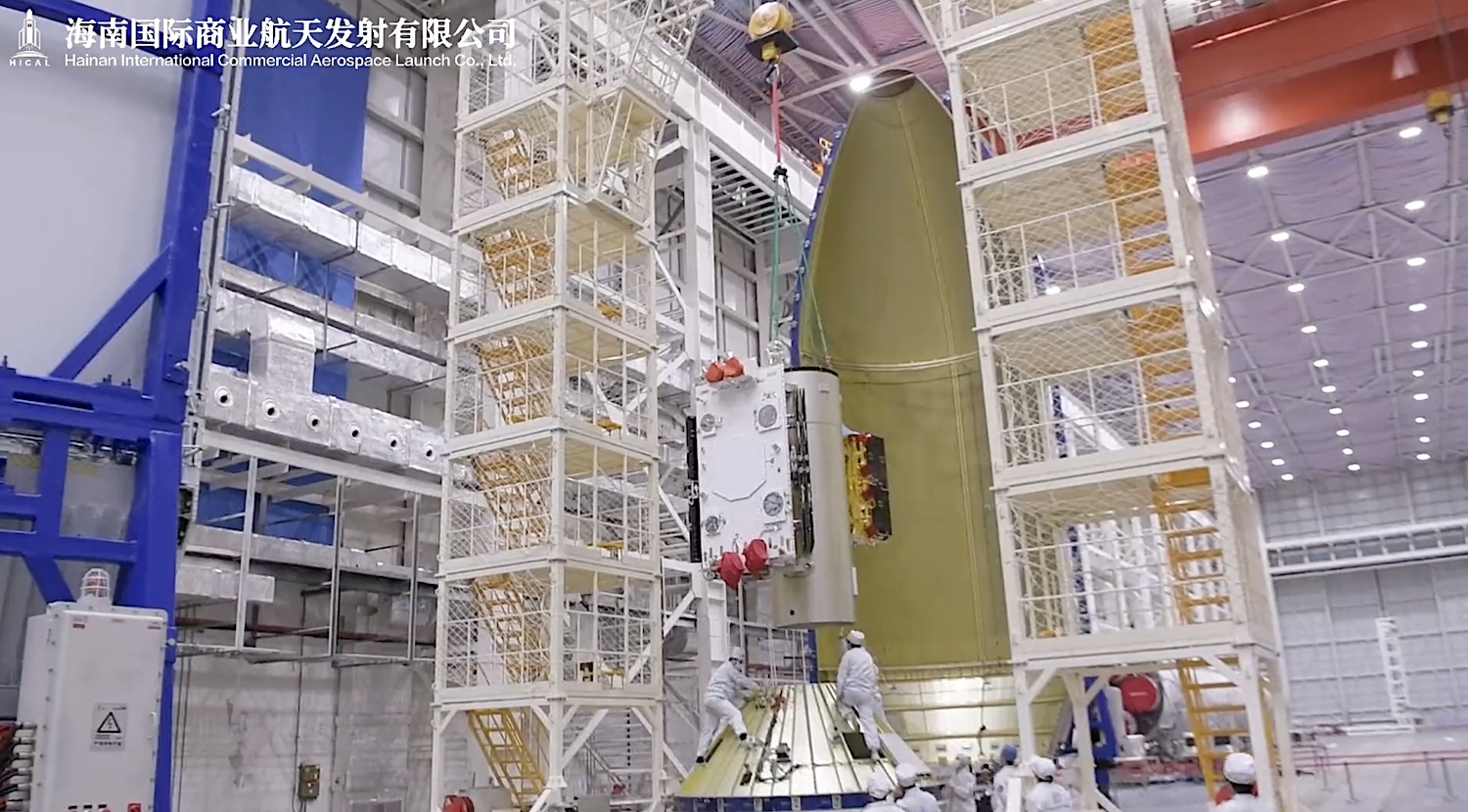
Hainan International Commercial Aerospace Launch Company Ltd.
Credit:
Hainan International Commercial Aerospace Launch Company Ltd.
Leader and follower
Why would China, with prospects in space technology far outclassing those of Russia, seem so eager to partner with a lesser power in these kinds of programs? One reason is that Russia’s military, from the ground to space, is battle-tested with opportunities to rapidly test new capabilities in combat. This has come at a staggering cost of 1.4 million Russian casualties since the invasion of Ukraine began in 2022. China’s military lacks this real-world combat experience.
At the same time, Russian officials know China has significantly more resources to pour into expensive rocket and satellite developments, with expertise in chips and electronics. China is already reportedly providing training, tooling, and hardware for electronics on a wide range of “Russian-made” weapon systems deployed in the Ukraine war.
“There are signs the plans have advanced considerably since the 2023 conference,” the reporters wrote in the story published last week.
Indeed, the escalation ladder describes some things that are already happening.
“I do think we are a couple rungs up that ladder,” Galbreath said. “The fact that they are choosing to head down the path of military options here, I think, speaks volumes about where they think we are in our relative competition with one another.”
Chinese media have reported that engineers developed a powerful ground-based microwave weapon that could threaten satellites in LEO, including Starlinks. Russia has technology designed to jam Starlink receivers on the ground. NATO intelligence services are monitoring Russia’s work on a concept to eject small pellets into a satellite constellation’s orbit.
China and Russia aren’t alone. The US Space Force recently unveiled its own ground-based satellite jammer.
And there’s Russia’s reported plan to place a nuclear weapon in orbit, a violation of the Outer Space Treaty of 1967. If Russia moves in this direction, a nuclear detonation in low-Earth orbit could be the ultimate Starlink killer. The problem is that it would spread clouds of radiation throughout near-Earth space, rendering much of low Earth orbit unusable for any space mission for months or years. The consequences of such an event would not only cripple Starlink and US satellite networks but also those of Russia and China themselves.
“Any mission set that you can execute from low-Earth orbit becomes at risk by the mechanisms or means that China and Russia could develop to counter SpaceX and Starlink,” Galbreath said. “Communications, obviously. Imagery, absolutely. When you think of a constellation like Planet’s Dove (commercial imaging) constellation, that could become at risk as well.”
The same goes for the Pentagon’s proposed Golden Dome missile shield and the emerging use of satellites for battlefield targeting.
“All of those become at risk if China and Russia develop a successful means of countering Starlink,” Galbreath said.