50 Years Later: The First Photo Ever Taken on Mars
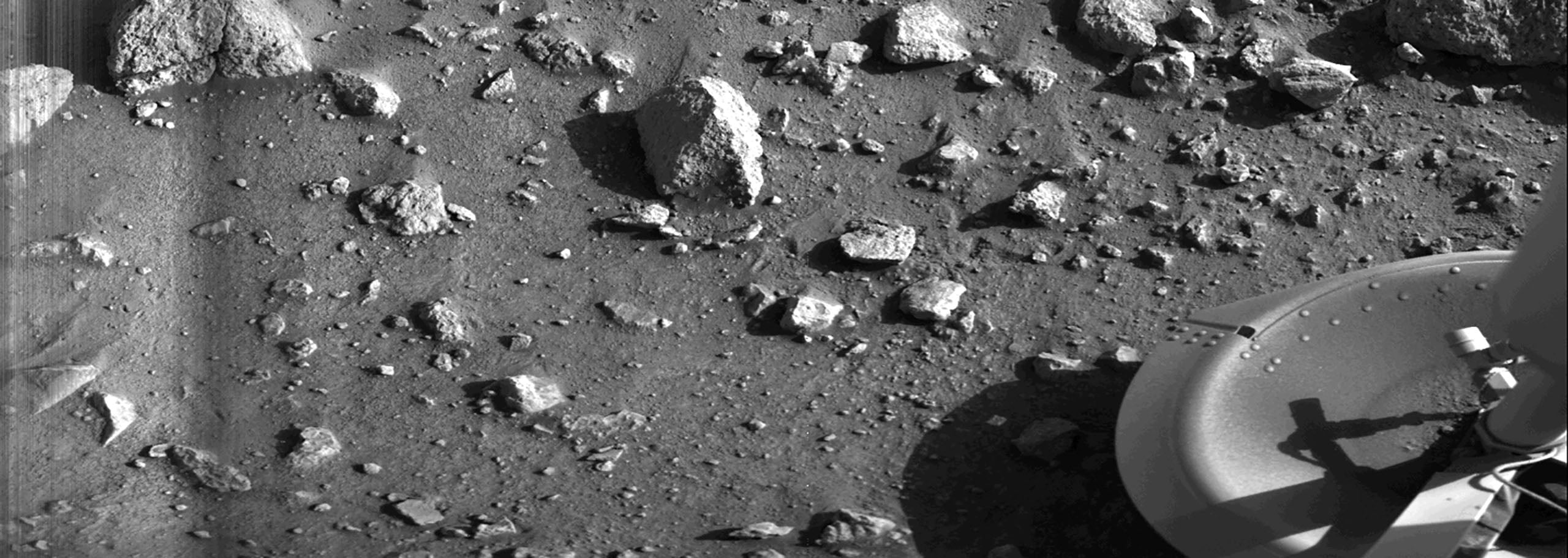
This week marked the 50th anniversary of the NASA Viking 1 spacecraft landing safely on Mars, spearheading a new era of space exploration. Just minutes after Viking 1 landed on the Red Planet, it captured a photo, the first ever taken on the surface of Mars and the first time any human had ever seen a photo from another planet.
On July 20, 1976, when Viking 1 touched down on Mars’ dusty surface, it broke incredible new ground. The Viking 1 lander touched down on the western slope of Chryse Planitia, or “the Plains of Gold,” and almost immediately began its scientific missions. Viking 1 and its sibling lander, Viking 2, were tasked with capturing photos, collecting data, and conducting experiments searching for evidence of life on Mars.
Each Viking lander had two identical cameras onboard. Given the nature of the mission, which required data to be transmitted to the accompanying Viking orbiter above Mars and then back to Earth, film cameras were not an option. The landers were equipped with a pair of 7.3-kilogram broadcast cameras, each with 12 silicon photodiodes. These cameras, mounted 0.8 meters apart, delivered a stereo view of Mars and very slowly scanned the scene. The scanning rate was synchronized with the data transmission speeds, which were about 16,000 bits per second to the orbiters. The orbiters then sent data to Earth at 250 bits per second.
While these cameras were exceptionally slow by modern standards, this was 50 years ago, on Mars, about 225 million kilometers (140 million miles) away from Earth. What a remarkable accomplishment. When that first photo was finished scanning and then beamed back to Earth, it gave humanity its first-ever view of what it looked like from the Martian surface. For that alone, the Viking 1’s cameras are spectacular.
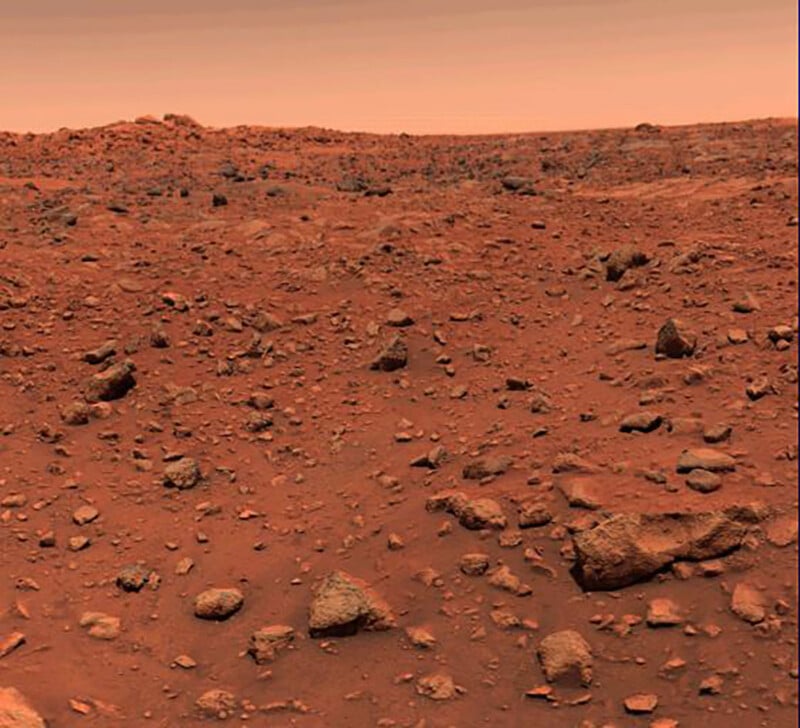
40 minutes after Viking 1 touched down on Mars, so at 5:52 AM PDT, mission controllers got their first glimpse of Viking’s first images. The photo appeared one narrow strip of data at a time.
“I studied the black screen, waiting for that narrow strip that will signal the first few lines of the first picture,” described Dr. Thomas Mutch, leader of the Viking lander imaging team. “And it appeared. A sliver of electronic magic. Areas of brightness and darkness.
“The picture begins to fill the screen. Rocks and sand are visible and — finally at the far right — one of the spacecraft foot pads, a symbolic artifact that stamps our accomplishment with the sign of reality. Time and time again I repeat, ‘It’s incredible.’”
In the past 50 years, humanity has learned much more about Mars and captured so many stunning photos. All of this remarkable science and discovery owes an enormous debt to the Viking 1 and Viking 2 missions.
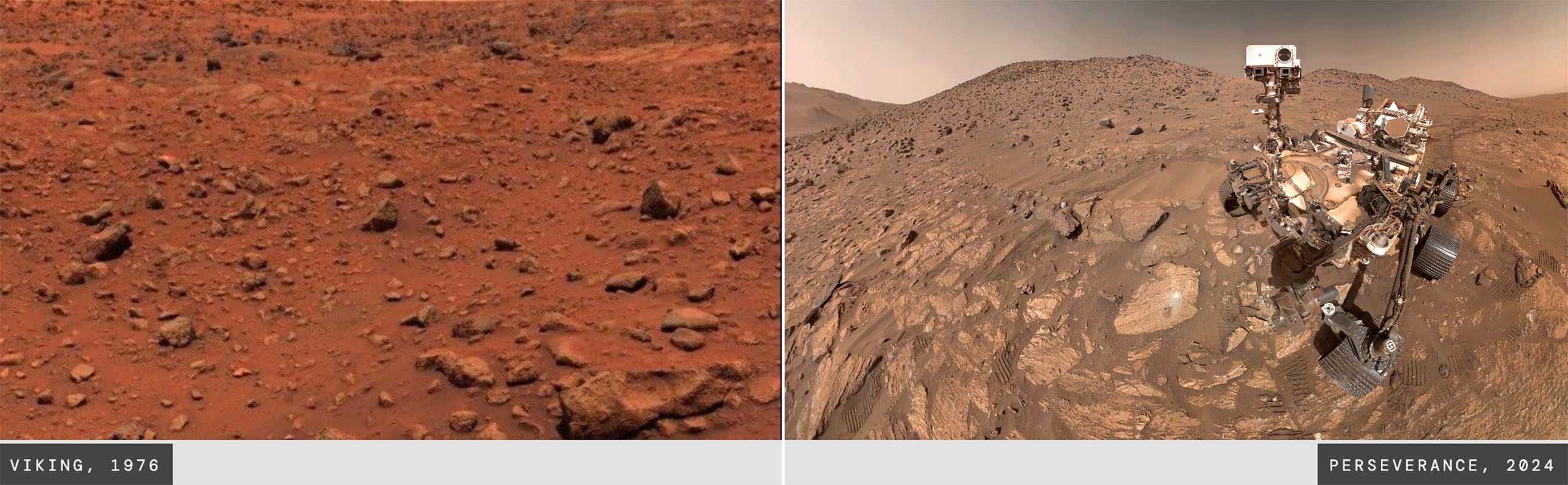
“What was once only visible from a distance, we could now reach out and grasp,” NASA explains.
Image creditsNASA/JPL