First-of-its-Kind Footage Shows the Ocean From a Whale Shark’s Perspective
Researchers attached cameras to whale sharks, the world’s largest known fish, to witness krill chases for the first time and gain exciting new insights into how these beloved fish forage and snack.
As researchers from Murdoch University in Western Australia describe, whale sharks are “one of the most charismatic marine species.”
“They connect with the hearts of anyone lucky enough to encounter them, making people deeply curious about their lives and invested in their conservation,” researchers Christine Barry and Luciana C. Ferreira explain.
Because whale sharks are so exciting to watch underwater and are gentle giants, most of what scientists and marine biologists know about whale sharks and their behavior comes from people watching them from their boats.
“Much of their lives below the surface remains a mystery,” the researchers explain.
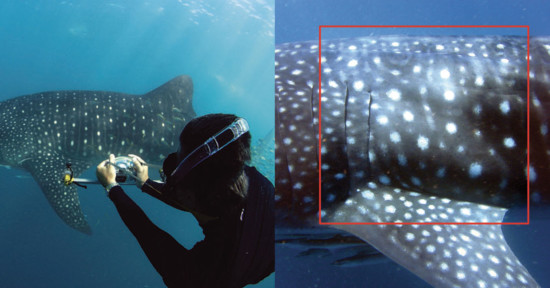
New research published in Marine Biology details how Barry, Ferreira, and a team of other researchers from Murdoch University’s Australian Institute of Marine Science attached cameras directly to whale sharks to learn more about their lives and behaviors.
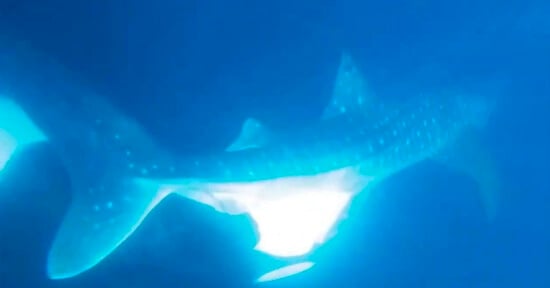
The images effectively captured by the whale sharks showed never-before-seen behaviors, including whale shark foraging behaviors inside water columns all the way at the bottom of the sea.
“Through our new study, we could finally address the question: ‘what do whale sharks do when no one is watching?’ Filling these research gaps is essential so we can help these majestic, yet endangered filter-feeding animals,” the researchers write.
The marine biologists attached combination tags to their whale shark subjects that collect high-resolution movement data. These tags also have a small camera that captured footage of the front half of the shark plus the sharks’ own points of view.
“It’s as close as we can get to seeing the ocean through their eyes,” the researchers say.
The team used its fantastic video data alongside information from more than 100 scientific publications to create the world’s largest catalog of whale shark behaviors. The team has defined 36 distinct whale shark behaviors.
Of these 36 behaviors, the camera-carrying whale sharks performed six of them most frequently, all low-effort feeding tactics.
“This suggests they often snack in water with low prey density until they come across a patch with higher prey density, such as a krill swarm. Then, their behavior changes to active feeding. It’s like snacking from the pantry while you decide what you’re going to cook for dinner,” Barry and Ferreira write.
The team also found that whale sharks have a “much wider variety” of foraging strategies compared to other filter-feeding megafauna on Earth, like whales or basking sharks. This diversity of strategy could help explain why whale sharks can thrive in tropical waters with relatively limited prey.
Thanks in very large part to cameras, scientists are “beginning to understand the secret lives of the biggest fish on Earth.
“From what we have seen, they are the ultimate snackers of the sea.”
Image creditsResearch by Christine Barry, Luciana C. Ferreira, et al. ‘An ethogram for the whale shark (Rhincodon typus) with insights into foraging plasticity‘ was recently published in Marine Biology. Featured photo licensed via Depositphotos.com.