Canon Patents Three-Group Lens Designs That Promise Faster Focus
Canon’s latest lens patent is interesting mostly because of what it represents than the specific lenses detailed. The patent features an interesting three-group lens design that Canon says delivers faster autofocus performance, all else equal.
As Canon Rumors observes in its reporting, Canon has spent considerable effort reducing the size of its fast-aperture lenses during the RF-mount era.
The company’s VCM Series lenses are particularly strong examples of how Canon has worked to shrink the size and weight of its lenses while simultaneously increasing autofocus speed. There are numerous ways companies like Canon can shrink their fast-aperture lenses without compromising autofocus speed or overall imaging performance, and sometimes even make them faster and smaller. The VCM lenses reflect many of these approaches.
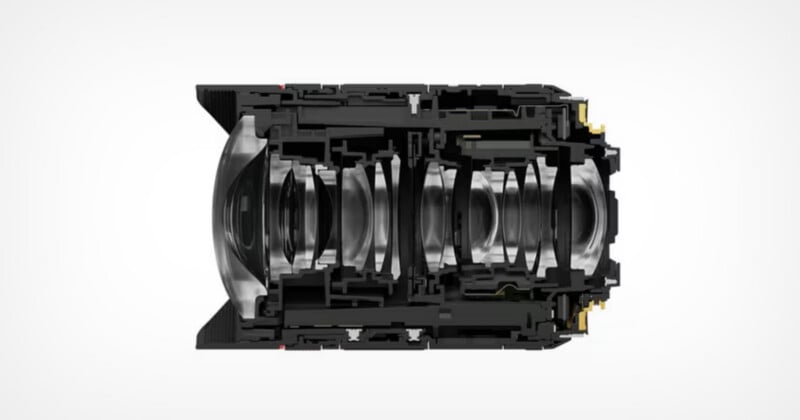
They utilize Voice Coil Motor (VCM) autofocus motors alongside Nano USM focusing. These are both compact and quiet autofocus systems, which require that the pieces of glass they physically move inside the lens to achieve focus are relatively small and lightweight too. All else equal, the less glass that focusing motors move, the faster focusing is. Further, the less glass that must be moved, the smaller these motors can be, and the smaller the overall lens is.
As PetaPixel recently wrote concerning longitudinal chromatic aberrations, lens design is a constant push-and-pull process. Changing any part of a lens has cascading effects on the rest of the design, and many of the objectives of lens engineers directly compete against one another. It is a constant balancing and rebalancing act to achieve the right combination of size, weight, performance, speed, and, of course, price.
As optical technologies improve, including materials, precision, and shaping, engineers have more options in how they design lenses. Very few aspects of lens design have as much of an impact on the final design and performance as the size, weight, and amount of glass inside a lens. Achieving similar or superior performance with fewer, smaller elements is a huge win. Ultimately, that’s really why Canon’s newest patent matters.
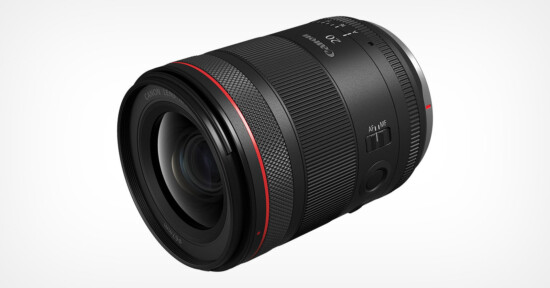
“We want to develop lenses that will amaze users,” said Canon mechanical designer Noboyuki Nagaoka, who recently worked on the RF 14mm f/1.4L VCM, a strong example of a fast, ultra-wide lens with swift autofocus. “As a mechanical engineer, I’ll continue to focus particularly on achieving lightweight designs.”
There is not necessarily a specific, groundbreaking lens in Canon’s new patent, and none of the outlined lenses are guaranteed ever to see the light of day. Some of them even overlap with existing high-quality RF lenses. However, Canon’s patent provides fertile ground to think about all the factors involved in making new lenses that check all the right boxes: size, performance, and price. The patented optical design technology reflects the company’s broader ambitions, and for that alone, it’s interesting.
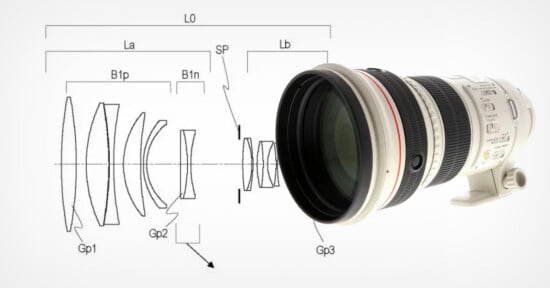
The patent outlines 21 different lens designs, each demonstrating what is possible through a three-group lens design. The front and rear groups are both fixed, effectively tasked with directing light through the lens onto the sensor so the final image is sharp and as free as possible from aberrations. The middle group is the only one that moves in Canon’s new patent, and it is the focusing group.
There are many interesting lens designs in the patent, including 14mm f/2, 15mm f/1.4, 16mm f/1.8, and 12mm f/1.2 wide-angle primes, but the meat and potatoes here is the general concept of combining negative and positive refractive powers inside a lens in such a way that Canon utilizes fewer, smaller lens elements. As mentioned, this enables faster autofocus, especially in light of Canon’s ever-improving autofocus motor technology.
Image creditsCanon

As Canon explains in a machine-translated version of its patent, the goal of the outlined technology is “to provide a compact optical system capable of high-speed focusing.” The solution is, as mentioned, a three-group lens design. The front group has negative refractive power, the middle group handles focusing, and the rear group has positive refractive power.
It isn’t like current Canon RF lenses are big or slow — they are impressively compact, lightweight, and fast — but Canon’s new patent shows that the company is constantly investigating novel ways to shrink lenses further and improve focusing speed. It’s an interesting patent to keep in mind as Canon designs and launches new lenses, particularly those with fewer optical groups.
Image creditsCanon
Affiliate Disclosure PetaPixel articles may include affiliate links; we may earn a commission if you buy through one.