Sony 100-400mm f/5.6-8 Review: It’s Just Fine and That’s Okay
Many of Sony’s recent lens efforts have focused on high-end, professional-grade optics, including G and G Master lenses. The company is revisiting the consumer end of its lineup, delivering a new telephoto zoom lens for the masses: the FE 100-400mm f/5.6-8 OSS. It’s aggressively priced and versatile, but is it any good?
The Sony 100-400mm f/5.6-8 OSS gives Sony owners an affordable way to get more telephoto reach and capture good-quality photos with all the perks of a native Sony lens.
Pros
- Relatively compact and lightweight
- Acceptable image quality
- The most affordable 100-400mm lens for E-mount
Cons
- Unremarkable performance across the board
- Slow aperture
Coincidentally, this is Sony’s second new 100-400mm lens of 2026, following the fantastic FE 100-400mm f/4.5 GM lens released alongside the a7R VI in May. But make no mistake, just about the only thing Sony’s two new 100-400mm telephoto zoom lenses have in common is their focal length range. The two lenses target extremely different users.
While the $4,300 100-400mm f/4.5 G Master is built explicitly for high-end amateur and professional users who have big budgets and few qualms about using a big lens, the $850 FE 100-400mm f/5.6-8 OSS is for folks who don’t want to spend thousands of dollars to get good reach, don’t care about ultimate image quality, and are more concerned about getting a good photo than getting the best one.
Sony FE 100-400mm f/5.6-8 OSS Review: How It Feels
The Sony FE 100-400mm f/5.6-8 OSS is a relatively affordable lens, and it feels like it. It doesn’t feel as high-end as Sony’s G lenses, and certainly not as well-built as the company’s flagship G Master ones. The new telephoto zoom is plasticky.
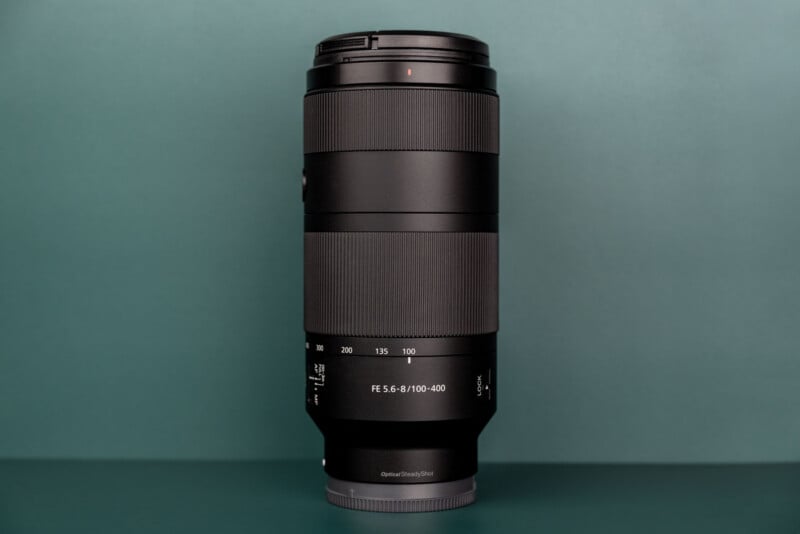
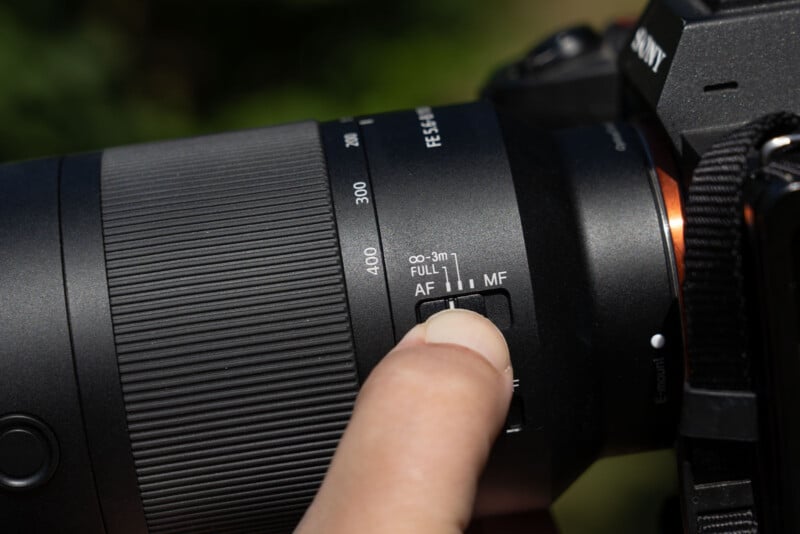
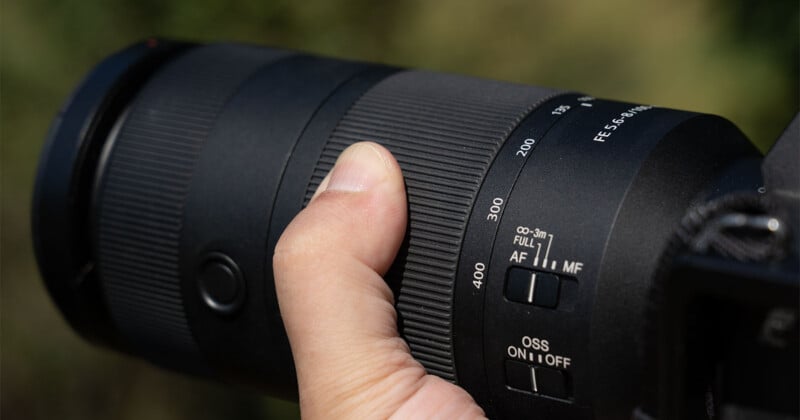
However, it’s far from all bad news here. While the lens generally doesn’t feel incredible in the hands, the zoom ring feels nice, offering a respectable amount of resistance and precision. The lens has a custom function button and on-barrel controls for the autofocus range and whether the Optical SteadyShot (OSS) stabilization is enabled. It never fails to annoy me when I have to go into the camera’s menus to switch to manual focus or disable optical stabilization, so I’m happy Sony has physical switches for these.
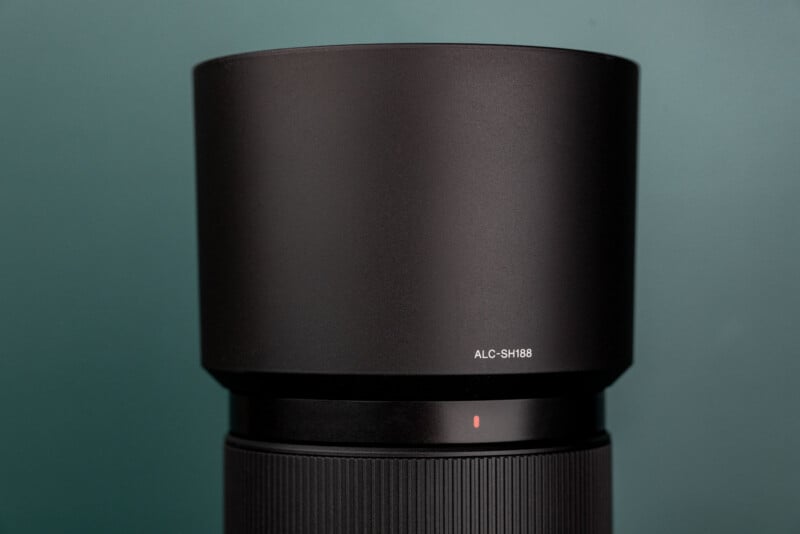
The lens also has a dust- and moisture-resistant design with silicone gaskets throughout the barrel, including at the lens mount, and it ships with a lens hood included. Canon could take a hint there, since the company doesn’t include lens hoods with any of its non-L glass.
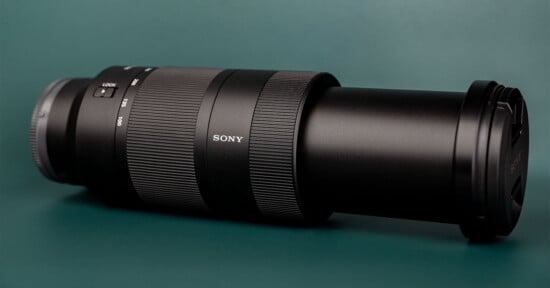
But perhaps the best thing the FE 100-400mm f/5.6-8 lens has going for it is that it is reasonably compact and lightweight. The lens weighs 654 grams (23 ounces) and is 164.5 millimeters (6.5 inches) long. It accepts 67mm front filters. It’s an easy lens to hold, and even though it extends a fair bit when zoomed, it always feels reasonably balanced in the hand.
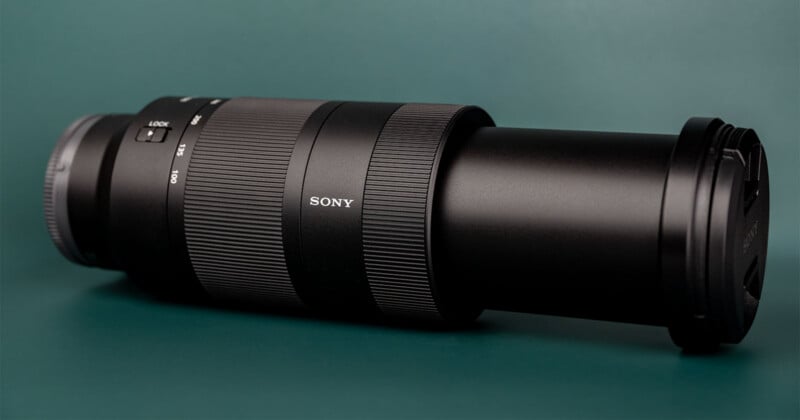
Sony’s lens doesn’t feel quite as good as the Sigma 100-400mm f/5.6-6.3 DG DN OS Contemporary, but it’s also $200 less expensive and nearly 500 grams lighter. Sony’s new 100-400mm is $450 less expensive than the admittedly more versatile Tamron 50-400mm f/4.5-6.3 Di III VC VXD, but it’s also a bit smaller and lighter. Obviously, Sony’s lens is slower than those Sigma and Tamron telephoto zooms, but the point is that Sony has delivered a pleasantly lightweight full-frame telephoto zoom lens.
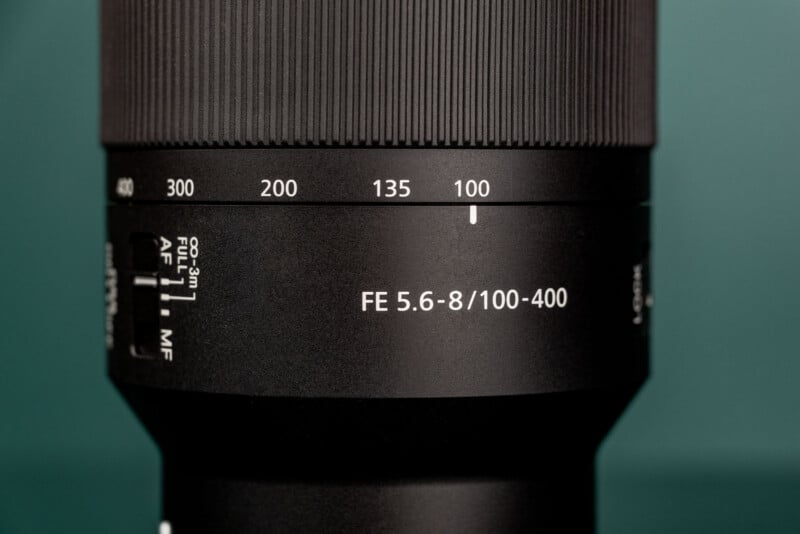
Overall, there’s not much to dislike about the overall look and feel of Sony’s new FE 100-400mm f/5.6-8 OSS lens. It isn’t particularly exciting looking, nor is it especially well-built, but for its price, it feels solid. It’s entirely competent and enjoyable enough to use. It meets my expectations for its segment.

Sony FE 100-400mm f/5.6-8 OSS Review: How It Shoots
This theme of competence without excitement continues with image quality and the overall shooting experience. The Sony 100-400mm f/5.6-8 OSS lens is pretty good at just about everything, with the expected drawbacks in tow.
By far the biggest knock on the Sony 100-400mm f/5.6-8 lens has to be its speed. The fastest aperture of f/5.6 isn’t fast to begin with, and by 135mm, the lens already slows down to f/6.3. It slows to f/7.1 at 180mm and its sluggish f/8 aperture at 220mm.

Even though many of the latest cameras are pretty good at high ISO settings like 1600, 3200, and even 6400 and beyond, that doesn’t mean I want to be shooting at them all the time. Unfortunately, unless shooting in very bright light or when ignoring the telephoto end of the lens, you will spend a lot of time shooting at high ISOs and incur the resulting image quality penalty, whether it’s the relatively small one of Sony’s latest and greatest cameras or a much bigger one with an older Alpha body.

If f/8 isn’t slow enough, the lens is, for some reason, compatible with Sony’s 1.4x and 2x teleconverters. While I did not test the lens with these teleconverters, I would recommend against them and instead suggest heavily cropping your photos when you need more reach. A 200-800mm f/11-16 lens is extremely limited in its utility, and that’s not even considering the inevitable image quality degradation.



On the plus side, the lens’s optical quality is solid. At its best, the lens is reasonably sharp, consistent, and not riddled with aberrations. There are some compromises, though. You give up a bit of performance in the corners, for example.


Speaking of close-up performance, the Sony 100-400mm f/5.6-8 OSS has a maximum magnification of 0.41x, which is pretty solid. It’s not quite half-macro territory, but it’s not bad.



When you can get really close to your subject and have a distant background, even with the limitations of f/8, the backgrounds can be reasonably soft and smooth. The lens has a nine-bladed aperture diaphragm, and overall bokeh rendering is fine. Bokeh is not quite as clean or nice as a Sony G or GM lens, of course, but it ranges between “not bad” and “pretty good.” It’s hard to ask much more from a lens like this.
In terms of autofocus performance, the lens’s pair of linear motors — not XD Linear Motors — do fine. Although a Sony a9 III owner is very unlikely to use the Sony 100-400mm f/5.6-8 OSS lens, it does support up to 120 frames per second AF/AE tracking on that camera.


In practical use cases, autofocus performance is fine, if a bit indecisive. The lens doesn’t quite nail autofocus in every situation, especially not when operating at or near minimum focusing distances. I found that it didn’t keep pace with subject movement as well as Sony’s best lenses, which makes perfect sense.
The Sony 100-400mm f/5.6-8 OSS met my expectations in most situations, but in fairness, the bar was pretty low. It’s an $850 full-frame telephoto zoom lens, so it won’t be the world’s sharpest telephoto zoom, nor the fastest, and it certainly won’t have the cleanest image quality or swiftest autofocus.

What the lens is, though, is capable of taking pretty good photos in everyday outdoor situations. When the light is bright, and the subject is reasonably still and not right up against the background, the new Sony 100-400mm delivers nice photos.
Sony FE 100-400mm f/5.6-8 G OSS Review: A Good Affordable Telephoto Zoom Lens With the Expected Drawbacks
The Sony FE 100-400mm f/5.6-8 OSS is woefully boring, but that’s not necessarily a bad thing. If I want groundbreaking, exciting optical designs, I look to Sony’s G Master lineup. But those are very expensive lenses and therefore inaccessible to most photographers.
The $850 100-400mm f/5.6-8 OSS is an everyman’s lens, and these are very important to have in a healthy camera ecosystem. Sony E-mount photographers now have yet another option in this space, and it’s the most affordable one yet. That is good news.

Honestly, if a lens in this segment wasn’t boring, the odds are high that it would be for all the wrong reasons. The Sony 100-400mm f/5.6-8 OSS is sharp enough, has good enough autofocus, and is perfectly pleasant to use, at least when the light is bright.
Sony’s new telephoto zoom lens does what I want a lens in this class to do, and it makes telephoto photography more approachable for a wider audience. That is important. That the lens is not remarkable in any particular way is less important.

Are There Alternatives?
The most obvious competitor is the Sigma 100-400mm f/5-6.3 DG DN OS Contemporary. While this $1,049 lens is pretty long in the tooth, having launched in 2020, it is a very solid option. Its primary drawback, aside from its relatively heavier design, is that it is capped at 15 frames per second continuous shooting. However, I’m unconvinced that’s a meaningful compromise for most prospective buyers. In exchange for the extra $200 and nearly 600 grams, you get a noticeably faster aperture. That’s not a hard sell for me.
Then there’s the Tamron 50-400mm f/4.5-6.3 Di III VC. It offers the same aperture benefits of the Sigma lens but costs $1,299. That’s a pretty big premium to pay for some extra speed and being able to zoom out to 50mm. For someone looking for an all-around lens, the Tamron could be a compelling choice. It also has that 15 FPS cap, by the way, like all third-party E-mount lenses.
Within Sony’s own library, there’s really only one competitor, the FE 70-300mm f/4.5-5.6 G OSS. It’s currently $1,398, much faster, a G-series lens, and over a decade old. If you’re looking for more reach on a budget, I think you’re better served by opting for the new Sony 100-400mm or one of the two third-party options above. I would generally recommend against Sony’s old 70-300mm telephoto zoom lens.



Should You Buy It?
Maybe. This is not a particularly impressive lens, but it delivers upon its core promise. The Sony 100-400mm f/5.6-8 OSS gives Sony owners an affordable way to get more telephoto reach and capture good-quality photos with all the perks of a native Sony lens. That could be enough for the right photographer.
Image creditsAdditional photos by Jordan Drake. Product photos by Erin Thomson.
Affiliate Disclosure PetaPixel articles may include affiliate links; we may earn a commission if you buy through one.