2026 European Photography Awards Winners Offer Many Ways of Seeing the World
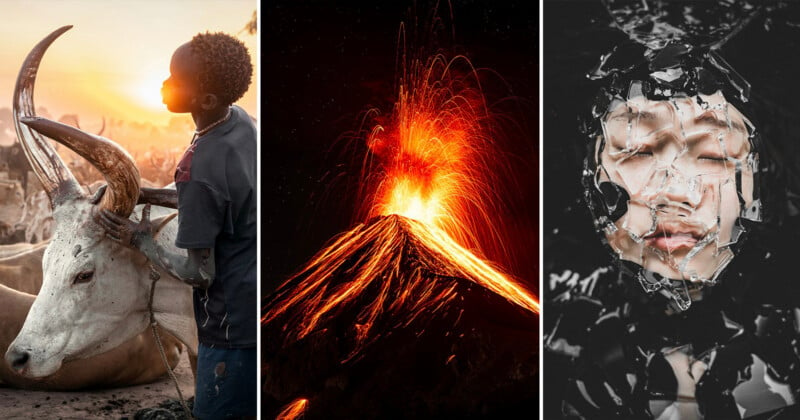
The best photographs do more than record a moment. The 2026 European Photography Awards celebrate images that pull us into one, inviting us to linger on a fleeting gesture, look again at a familiar place, or see the world from an unexpected perspective.
This year’s competition drew more than 3,000 submissions from photographers representing more than 40 countries. At the center of the awards are Canadian photographer Michelle Valberg and Germany’s Thea Mihu, named Professional and Amateur Photographer of the Year, respectively, alongside nine Category Winners whose work spans architecture, editorial, fine art, nature, and people photography.
Michelle Valberg Finds a Moment Between Species
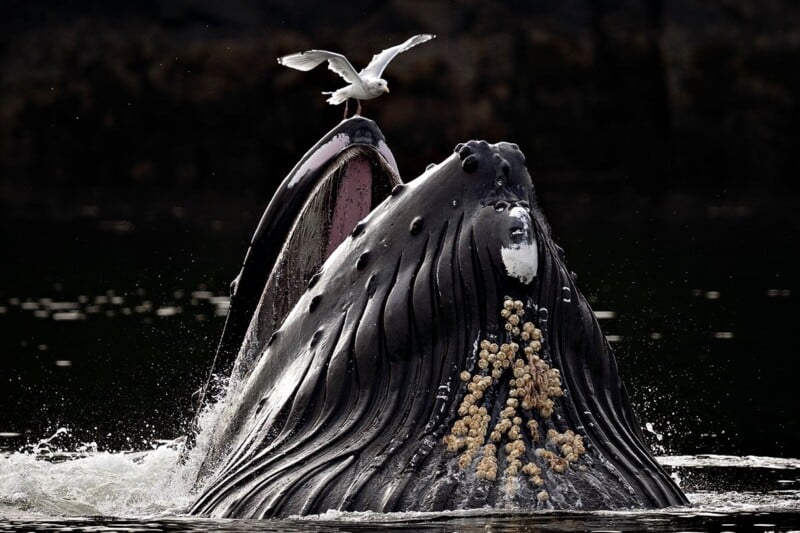
Michelle Valberg’s “Edge of the Feast” captures a split second of chaos in British Columbia’s Great Bear Rainforest. A humpback whale surges toward the surface with its mouth wide open, while a gull drops toward the opening, skimming the edge of the whale’s reach. Water folds around the whale’s jaw as the feeding event unfolds, bringing two species together in a fleeting moment of risk and opportunity.
The photograph was submitted in the Nature Photography – Wildlife category, where Valberg also received the Professional Nature Photography of the Year title. It ultimately earned her the competition’s highest professional honor, along with a $3,000 cash prize and the European Photography Awards statuette.
Valberg, who PetaPixel interviewed back in 2023, has spent more than four decades photographing wildlife and wild places across all seven continents. A Nikon Ambassador and recipient of the Order of Canada, she is known for combining wildlife photography with environmental storytelling, with projects ranging from spirit bears in the Great Bear Rainforest to polar bears in the Arctic.
She is also the Photographer-in-Residence for Canadian Geographic, a Fellow and Board of Governors member of the Royal Canadian Geographical Society, and a member of The Explorers Club. Her work has appeared on magazine covers, coins, postage stamps, public art installations, and in galleries worldwide. In 2026, she also received a gold medal in the wildlife category at the World Photographic Cup in Iceland.
That background gives “Edge of the Feast” a place within Valberg’s broader approach to wildlife photography. Rather than simply presenting the scale of a humpback whale, the image hinges on the relationship between the animals and the precise timing required to capture their interaction. The gull moves between danger and reward while the whale commits to the feeding moment, creating an image that speaks to both the intensity of the encounter and the fragile connections within the natural world.
For Valberg, photography has long been tied to conservation and connection. She founded Project North, a nonprofit initiative that delivered more than $2 million in sporting equipment to youth across more than 40 Arctic communities during its 17-year run. She continues to teach and lead photography workshops and expeditions focused on wildlife and wild places.
Thea Mihu Finds a Story in a Sea of Salt
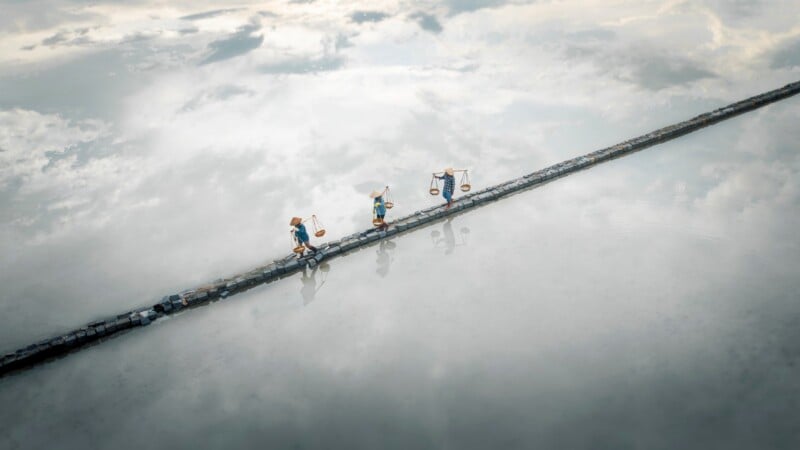
In Vietnam’s Hon Khoi Salt Fields, generations of workers have harvested salt by hand using nothing more than seawater, sunlight, and wind. German photographer Thea Mihu’s “The White Harvest” brings this centuries-old practice into view, documenting the traditional salt harvest in Dong Ninh Hoa Ward.
Across hundreds of hectares of shallow evaporation ponds, a small number of workers continue the physically demanding process of collecting salt. Mihu’s photograph emphasizes the enormous scale of the landscape against the few people working within it, turning the salt fields into both a portrait of labor and a study of the relationship between people and their environment.
As modernization reshapes traditional industries, the image becomes more than a record of how salt is produced. It captures a way of life that has endured across generations and raises a quieter question about what is preserved and what is lost as older forms of work give way to modern methods.
Mihu’s photograph was named Amateur Photographer of the Year, the highest honor in the competition’s amateur division. She receives a $2,000 cash prize and the European Photography Awards statuette.
The Professional Winners Find Stories in Unexpected Places
The professional category winners span five very different photographic worlds. Taken together, they reveal how broadly photography can interpret a subject, moving from the geometry of a city to the disappearance of communities and the raw physicality of wildlife.
Hong Kong’s Density Becomes an Abstract Landscape
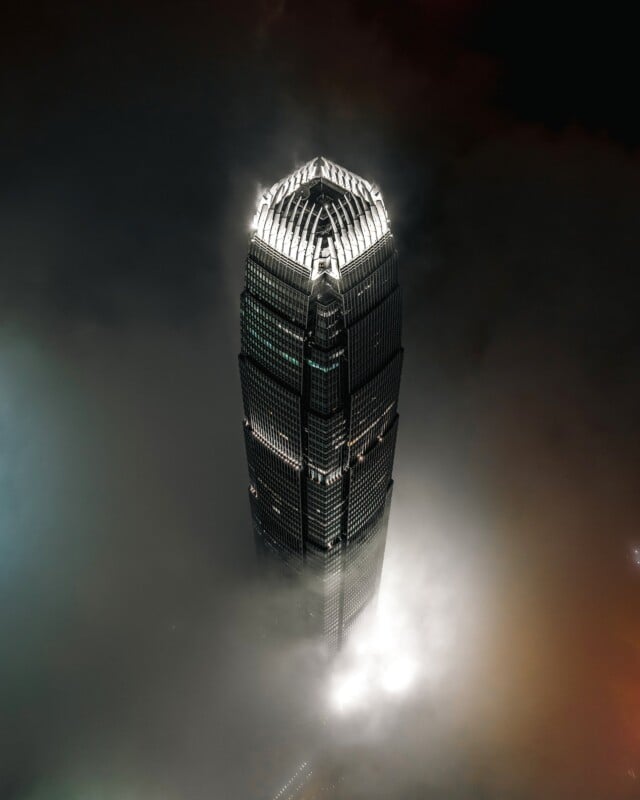
From the ground, Hong Kong can feel almost impossibly dense. Derry Ainsworth turns that density into something abstract in “Hong Kong From Above,” his Architecture Photography – Drone winning series.
Seen from directly above, residential buildings and corporate towers become patterns of geometry, repetition, and color. Kowloon’s tightly packed structures sit alongside the monumental scale of Central, while the perspective strips away much of the city’s visual familiarity.
Ainsworth’s background in architectural design informs the work, which explores the tension between the immense scale of human construction and the organic ways life finds its place within it. What might appear chaotic from street level becomes almost graphic when viewed from above.

Lucas Dragone Documents Life Amid a City in Transition
In Wuhan, demolition is changing entire neighborhoods. Lucas Dragone’s “Silent Resilience” looks at what remains in the spaces between what has already disappeared and what is still being lived in.
The Belgian photographer’s editorial series follows neighborhoods marked for demolition, where crumbling walls and rubble exist alongside the ordinary rhythms of daily life. Buildings are coming down, towers are rising, yet people continue to inhabit these transitional spaces.
There is no obvious spectacle in Dragone’s photographs. Instead, the series finds its strength in quiet observation, documenting the persistence of everyday life as the surrounding physical environment changes.
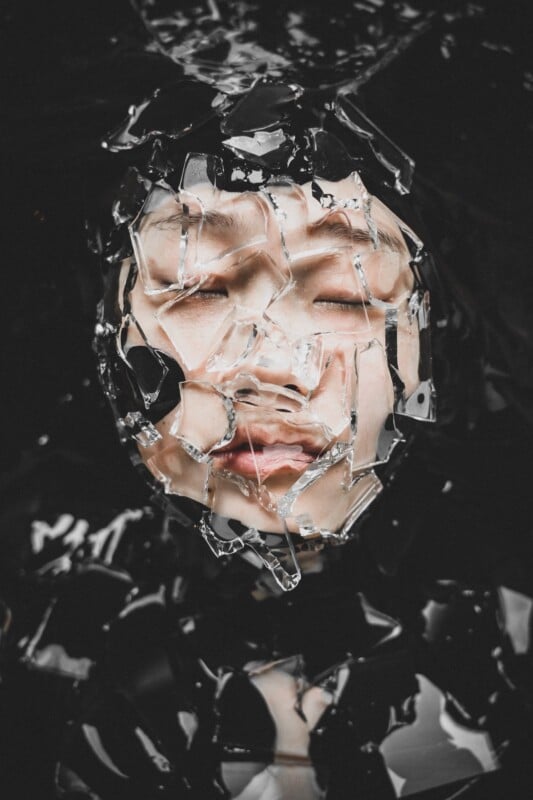
Eva Wang Turns Attraction Into Something Dark and Unsettling
Eva Wang’s “BLACK HOLE” takes a very different route. Named the Fine Art Photography – Portrait winner, the work uses the language of gravitational attraction as a metaphor for desire, obsession, and surrender.
“You’re like a black hole, irresistible to me. I’m absorbed, dominated. Lost my free will.”
The accompanying text describes a progression from attraction to complete loss of control, invoking “spaghettification” and the distortion of space and time. The result is a portrait concept that treats attraction as something simultaneously dark, dangerous, and impossible to resist.
King Penguins Stand Their Ground Against the Elements
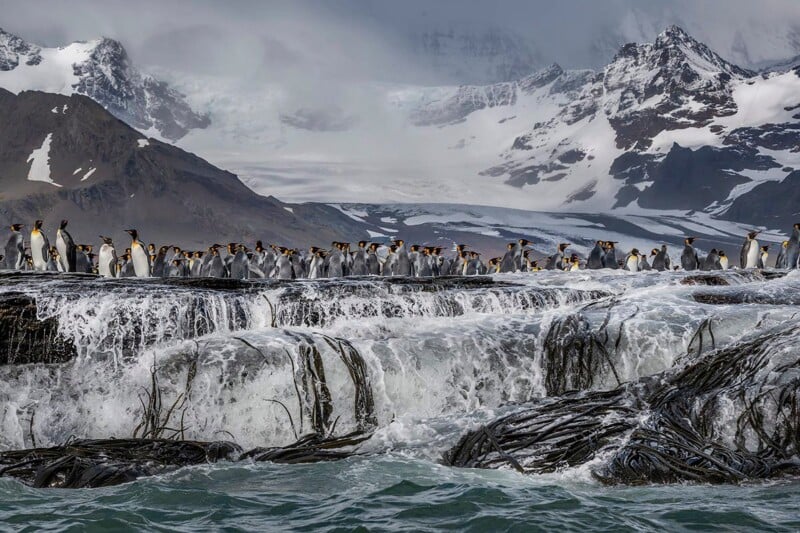
Valberg appears again among the professional winners with “Standing Tall,” her Nature Photography – Wildlife category-winning image.
Along the shore of South Georgia, a row of king penguins stands shoulder to shoulder facing into the wind. Waves surge around them, kelp twists in the foreground, and mountains rise behind the birds in the distance.
The composition relies on repetition and contrast. The penguins remain almost perfectly still while the water moves around them, and the distant mountains establish the remoteness of the setting. Together, those elements create an image about endurance, presence, and life holding its ground against the elements.
Roberto Pazzi Documents Cultures at Risk of Disappearing
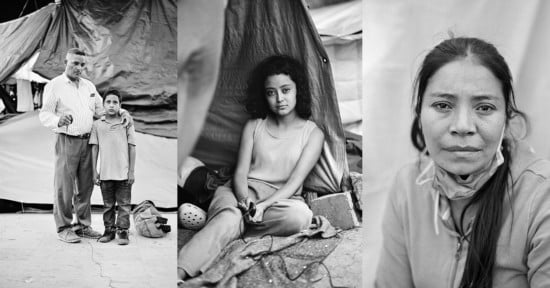
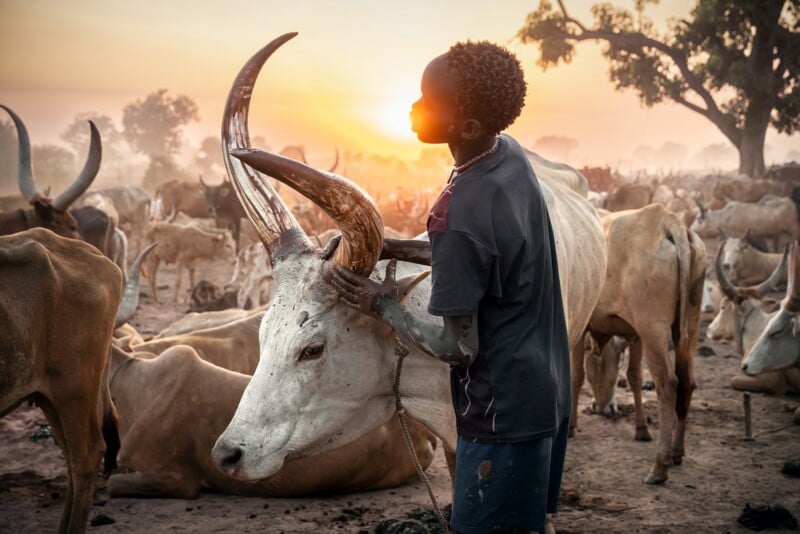
Roberto Pazzi’s “Vanishing Worlds,” the People Photography – Culture winner, turns the camera toward communities whose traditions and ways of life are becoming increasingly difficult to preserve.
The Italian photographer’s project travels through remote places and intimate moments, documenting rituals, languages, ancestral knowledge, and collective memories affected by globalization and technological change.
Pazzi does not frame these cultures simply as relics of the past. Instead, the project acts as a visual record of what exists now and what may eventually disappear. Each photograph becomes a fragment of a larger cultural memory, raising a question that extends beyond any single community: what do we lose when differences between cultures begin to disappear?
Amateur Winners Turn Their Cameras Toward Culture and Place
The amateur category winners similarly move across very different subjects, from the architecture of Montpelier to Indigenous traditions, volcanic activity, and cultures fighting to preserve their identity.
A Montpellier Landmark Takes on an Organic Form
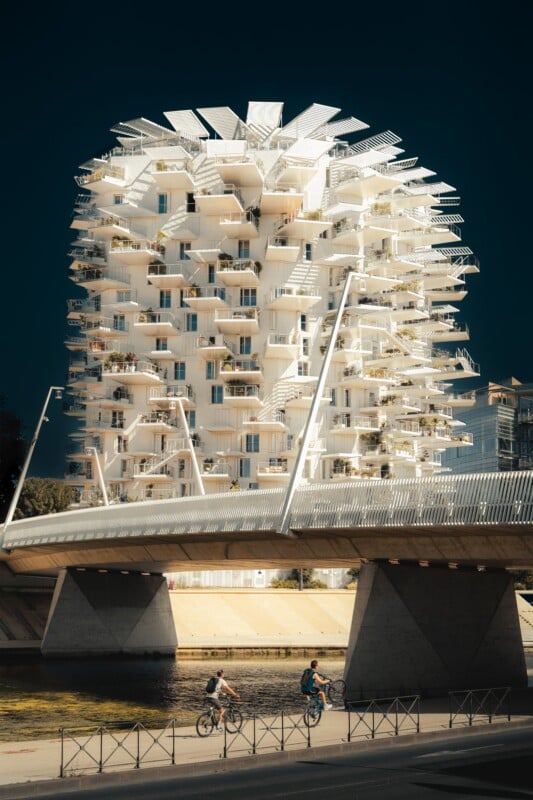
Felipe Martín-Serrano Ortiz’s winning architecture photograph brings a striking building down to human scale.
“L’Arbre Urbain: Montpellier’s white canopy” depicts L’Arbre Blanc, designed by Sou Fujimoto, from below. Its enormous cantilevered balconies extend outward like branches, creating the impression of an artificial tree against a deep blue sky.
Cyclists passing beneath the structure provide a sense of scale, grounding the unusual architecture in Montpellier’s everyday life. The photograph finds something almost organic in a building defined by concrete, geometry, and engineering.
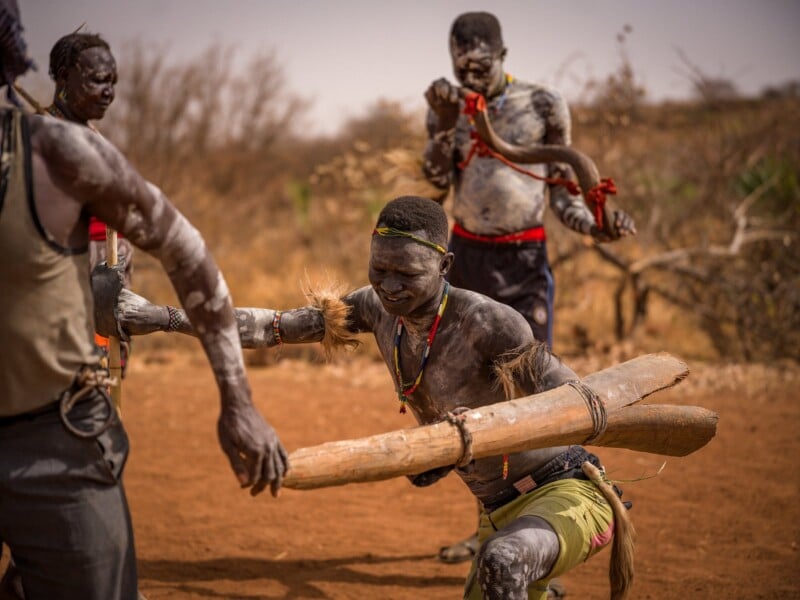
Philipp Schmieja Documents a Culture Determined to Endure
Philipp Schmieja’s “Survive to legacy” takes photography into South Kordofan, Sudan, where the Nuba people continue to preserve traditions despite decades of conflict, displacement, and outside pressure.
Among those traditions is wrestling and stick fighting, an ancient practice that has evolved from martial training into a celebrated cultural event. These gatherings, known as Big Sura, help represent individual villages and strengthen a sense of community, particularly during harvest seasons and festivities.
Schmieja’s documentary work places those traditions within a much larger history. The Nuba have faced pressure to abandon customs and ways of life, yet the photographs show a culture that continues to maintain its identity.
The project also carries a particular photographic history. Schmieja notes that these are among the first photographs of the Nuba made after the controversial work of Leni Riefenstahl in the 1960s and 1970s, bringing a contemporary perspective to a people who have rarely been photographed from outside the context of that earlier work.
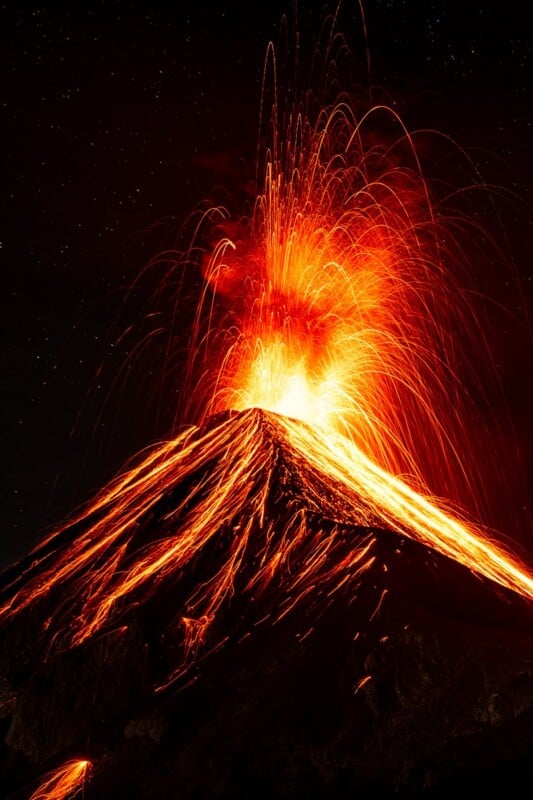
Fuego Volcano Turns the Night Into a River of Light
For Andreia Costa, the landscape itself became the subject.
“Veins of Fire,” the amateur Nature Photography – Natural Art winner, was photographed during an eruption of Guatemala’s Fuego volcano. For a few seconds, the volcano released lava and volcanic material into the night, transforming the darkness into a landscape of heat, light, and movement.
The photograph captures that brief transformation, when geological forces become visible against the night sky. It reminds us how quickly a landscape can change when something ancient and immense beneath the surface breaks through.
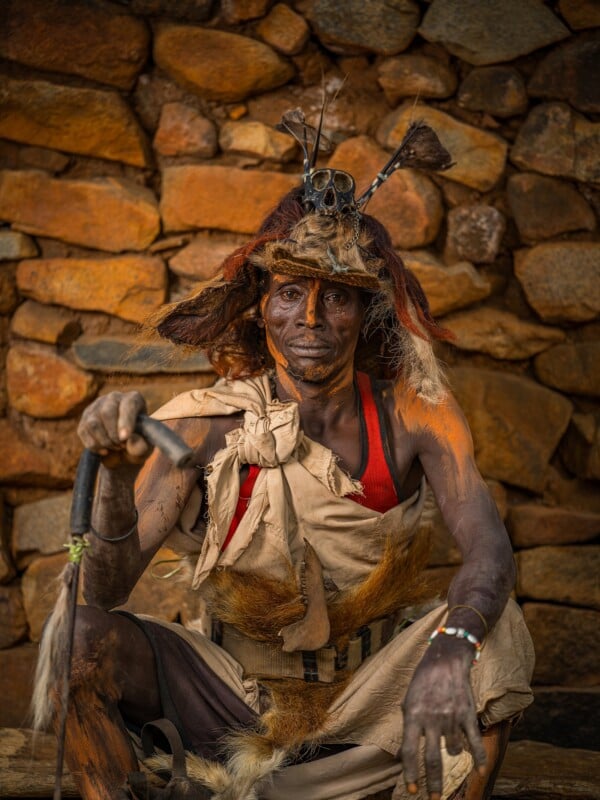
Photographs Preserve Traditions at Risk of Disappearing
Schmieja’s second amateur Category Winner, “Fading – the last of their kinds,” turns again to cultures confronting the loss of traditions.
The project considers how conflict, colonization, westernization, modernization, and forced displacement have affected Indigenous communities. Languages disappear, traditional dress and cuisine change, rituals and dances are transformed, and practices that once defined communities can become unfamiliar to younger generations.
The photographs are intended not as criticism, but as preservation. Schmieja describes them as fragments of different lives that bridge generations, documenting cultural knowledge before it is lost.
The project ultimately asks what happens when the world changes faster than memory can preserve it. Its photographs become both records of the present and reminders of how much cultural knowledge can disappear without leaving a visible trace.
The 2026 Winners Offer Many Ways of Seeing the World
The 2026 European Photography Awards were selected through a blind evaluation process from more than 3,000 submissions representing photographers from more than 40 countries. Beyond the two Photographer of the Year awards and nine Category Winners, the competition also recognized Platinum, Gold, and Silver recipients across 13 photography categories.
“The 2026 European Photography Awards winners represent an exceptional international body of photographic achievement,” said Thomas Brandt, spokesperson for the International Awards Associate.
“These honors celebrate photographers whose vision, discipline and command of the medium have distinguished themselves internationally. We are proud to recognize their achievements and present their work to a global audience,” Brandt says.
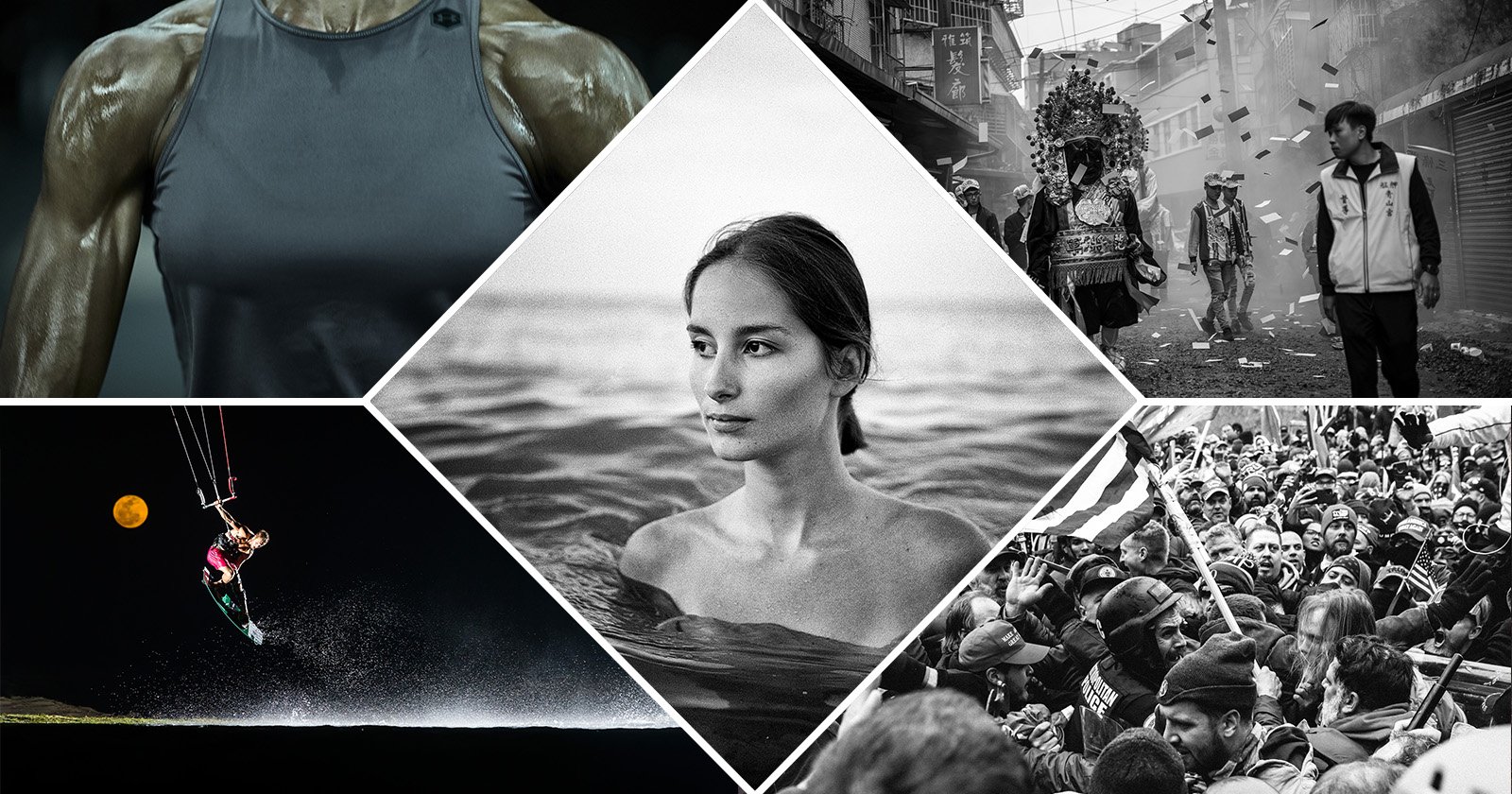
What emerges from this year’s winners is not one particular definition of photographic excellence. Instead, the collection moves freely between the intimate and the immense: a gull suspended above a whale, penguins facing the wind, a city seen from directly overhead, traditions held onto across generations, and a volcano briefly illuminating the darkness.
Each photograph begins with a particular moment or place. Together, they become something larger: a record of the ways photographers continue to look at a rapidly changing world, and the stories that can be preserved when they do.
Image creditsEuropean Photography Awards, Individual photographers as credited
Affiliate Disclosure PetaPixel articles may include affiliate links; we may earn a commission if you buy through one.