Apple Unveils M6, its First 2-Nanometer Chip, and the Extremely Powerful M5 Ultra
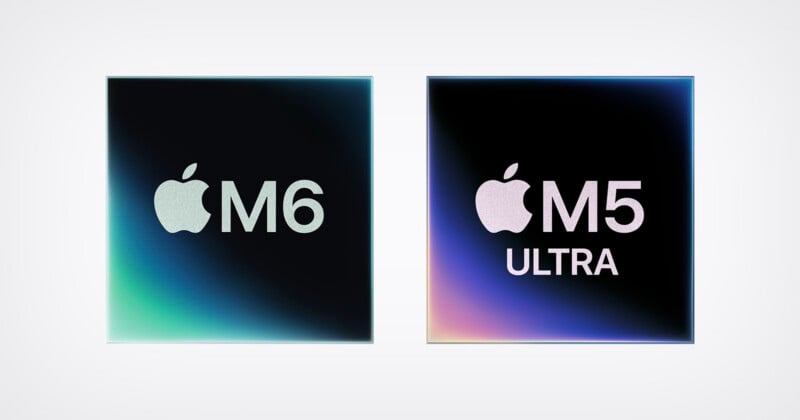
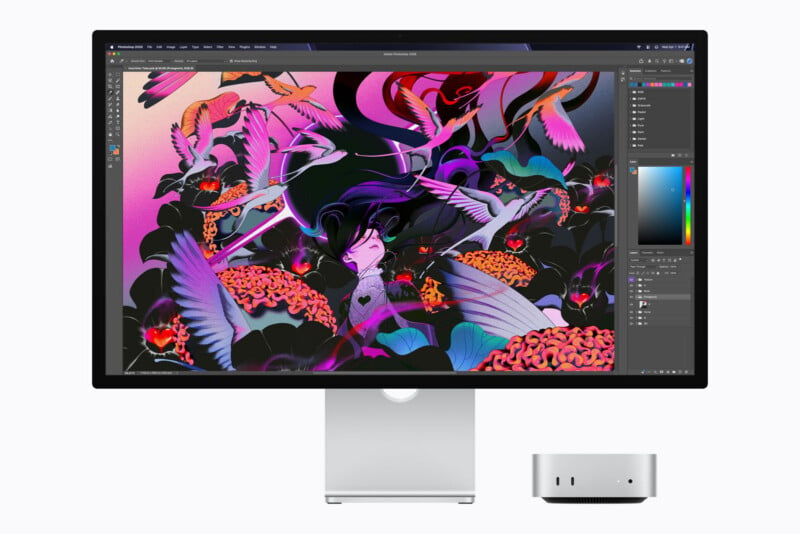
Apple just surprisingly unveiled the brand-new M6 and M5 Ultra chips. They are debuting in new, more powerful Mac mini and Mac Studio desktop machines.
“Today, we’re debuting the next giant leap in performance and AI compute for Apple silicon with the incredibly advanced M6 and the most powerful M-series chip yet, M5 Ultra,” says Sri Santhanam, Apple’s vice president of Silicon Engineering Group.
“Built using the cutting-edge 2 nm process, M6 combines a new CPU complex, two additional CPU and GPU cores, a Dual 16-core Neural Engine, and more unified memory bandwidth to power through workloads with amazing energy efficiency,” Santhanam continues.
“And for the ultimate desktop performance and the ability to run massive AI models, M5 Ultra features a massive GPU, now with Neural Accelerators, and more unified memory bandwidth, pushing the boundaries of what a desktop can do.”
Apple M6, the Company’s First-Ever 2-Nanometer Chip
The M6 is Apple’s first-ever 2-nanometer chip. Apple says the M6 is designed for everyday computing and promises an “ideal balance” of performance, power efficiency, and on-device AI compute.
“M6 is built using cutting-edge 2 nm process technology, packing greater transistor density into a smaller die for a major leap in performance and power efficiency,” Apple explains. “M6 also introduces a Dual 16-core Neural Engine, providing up to 2x the peak compute over previous generations to make on-device AI workflows run even faster.”
The new smaller, denser M6 chip features a brand-new 12-core CPU complex, two more cores than M5. Among these dozen cores are two super cores, four performance cores, and six efficiency cores. All 12 cores include a Neural Accelerator, which powers nearly 30 percent higher peak GPU compute for AI than the M5 and eight times better peak GPU compute than M1.
M6 boasts “the world’s fastest single-threaded performance,” and the chip is up to 1.2 times faster than M5 with multi-threaded workflows. Compared to the first M1 chip, the M6 is up to 2.4 times faster for multi-threaded performance.
The M6 supports up to 32GB of unified memory and has up to 170GB/s of unified memory bandwidth, a 10 percent increase over M5 and a 2.5 times increase versus M1.
Apple M5 Ultra, the Ultimate Powerhouse Chip for Mac
After Apple’s M4 generation skipped an Ultra variant, Apple’s flagship chipset has returned, promising absolutely wild performance.
The M5 Ultra, Apple’s most powerful chip ever, promises the ultimate CPU and GPU performance plus Apple’s best memory bandwidth. While the M3 Ultra paired two M3 Max chips using Apple’s UltraFusion technology, the M5 Ultra takes things up a notch. The M5 Ultra fuses two dual-die M5 Max chips to create Apple’s first “quad-die architecture.”
UltraFusion increases interdie bandwidth to over 4.4 TB/s and increases connection density by over six times. Together, the four dies all behave as a single, unified processor.
M5 Ultra features an up-to-36-core CPU with 12 super cores and 24 performance cores, which delivers up to 1.25 times higher single-threaded performance and up to 1.3 times higher multithreaded performance than M3 Ultra.
While that may not sound like much, the M3 Ultra remains the most powerful chip PetaPixel has tested for graphics-intensive workflows. However, it won’t hold that title for long, clearly. The M5 Ultra has a next-generation GPU with up to 80 cores, each with a Neural Accelerator. Apple says that peak GPU compute for AI applications is 4.5 times better than with M3 Ultra. Keep in mind, many photo and video editing tools rely on AI these days. Overall graphics performance is up to 40 percent faster than with M3 Ultra.
The M5 Ultra also has a more powerful Media Engine, including hardware-enabled H.264 HEVC, four ProRes encode and decode engines, and hardware-accelerated AV1 decode. Apple says M5 Ultra is the “ultimate solution for high-resolution video editing.”
The Apple M5 Ultra supports up to 512GB of unified memory, a new benchmark for Mac. The new chip has 1.2TB/s of unified memory bandwidth, 50 percent higher than the M3 Ultra.
Image creditsApple