Beyond Flash
Google announces Gemini 4 Argon AI model, but you can’t use it yet
So much for Gemini 3.5 Pro.
Credit:
Aurich Lawson
Credit:
Aurich Lawson
Google promised Gemini 3.5 Pro in June, but it spent the summer trotting out smaller Flash models. Now, Google is ready to take on the frontier again with Gemini 4 Argon. The company claims this new AI offers industry-leading performance in coding, knowledge work, and cybersecurity, but you aren’t allowed to use it yet.
While most of us will have to wait to test Gemini 4, Google says engineers inside the company are already using the new model extensively. Argon reportedly used “fleet-wide telemetry data” to help Google save 300 TiB of memory across its data centers. Meanwhile, Argon agents have been working to migrate C/C++ codebases to Rust across Google, including thousands of lines in the core re2 and libgav1 libraries and more than 800,000 lines in the Fuchsia OS Zircon kernel.
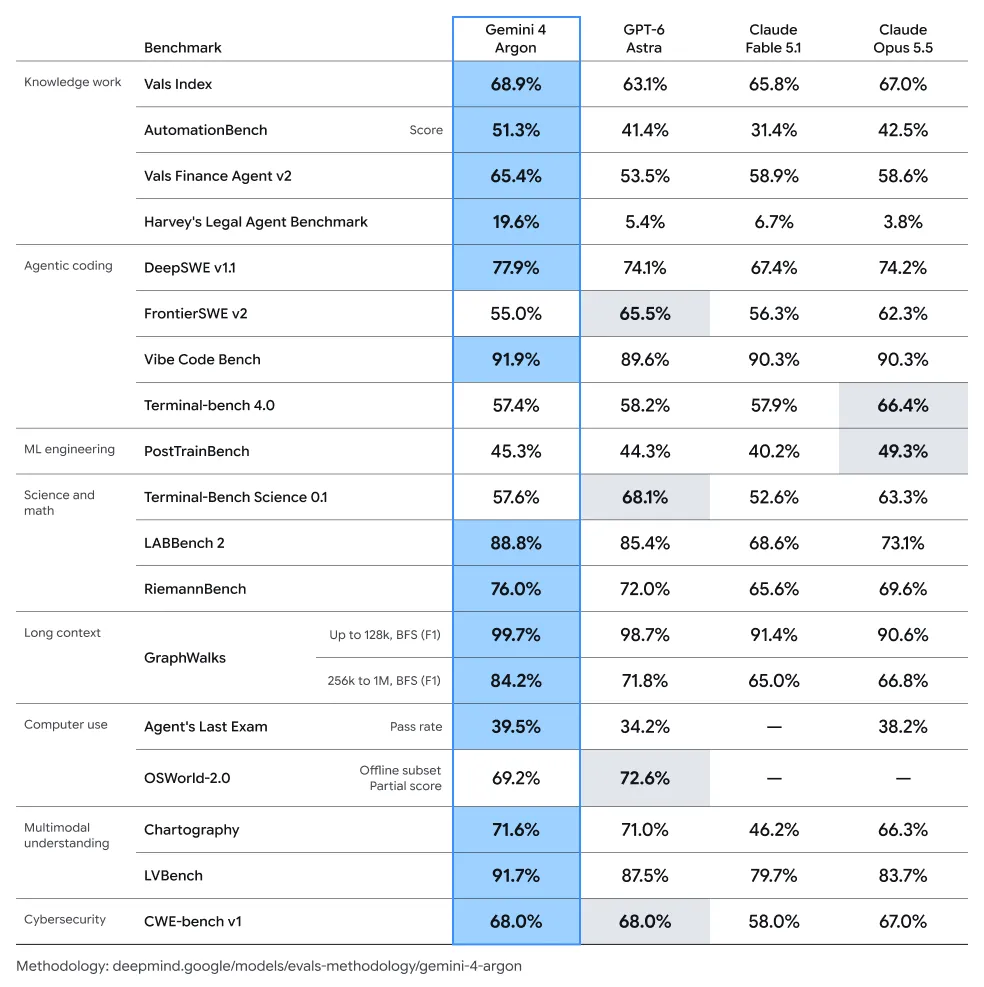
Google has also come armed with a raft of benchmarks to back up its claims. On the software engineering DeepSWE v1.1 benchmark, Gemini 4 Argon hits 77.9 percent, which is higher than GPT-6 Astra, Fable 5.1, and Opus 5.5. Google promises similar power across a range of long-horizon tasks, pointing to Argon’s industry-leading score in the economic analysis Vals Index test.
Credit:
Since this model is still in limited testing, Google has not announced API pricing yet. The company has, however, confirmed that Gemini 4 Argon will support a much higher output limit of 1 million tokens. That’s up from 64,000 tokens in previous Gemini models. Google says this allows users to complete more daunting tasks in a single step.
The main focus for Gemini 4 right now is cyberdefense. Google says models of this scale call for a phased release, so it’s starting with a small group of trusted testers. Partners in the company’s Fairwind Program can get access to leverage the model’s cybersecurity defense capabilities. Wiz is apparently already using Argon and has used it to uncover a critical vulnerability that could expose personal information in a system used at hospitals around the world. Google claims other frontier models missed this flaw, but it didn’t provide any specifics.
There’s a lot of hand-wringing about model misalignment after several high-profile hacking incidents over the summer. Google claims it designed Argon with systems that monitor the model’s chain-of-thought and can stop it in its tracks if the model steps out of bounds. This, Google says, is why reasoning transparency is important in frontier model development.
Gemini 4 Argon will eventually be available to enterprise and consumer customers, but Google isn’t making any specific timeline promises. We do know that following the cybersecurity tests, general availability will start with paid API users and Google AI Ultra subscribers.