Don’t mention it
Trump admin orders Kalshi to halt wagers on what words Trump will say
CFTC: Kalshi bets may violate US ban on contracts that can be easily manipulated.
Credit:
Getty Images | AFP
Credit:
Getty Images | AFP
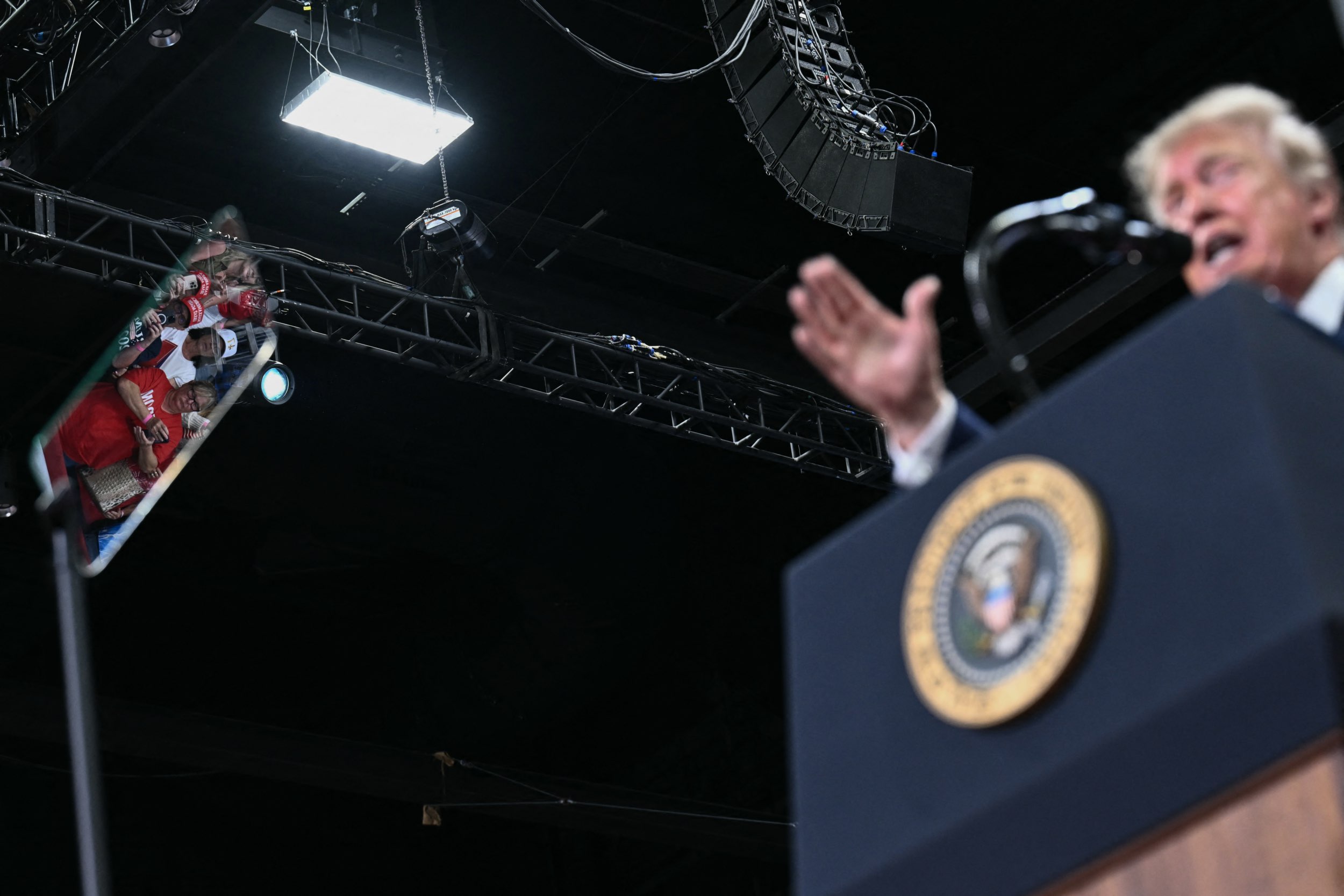
The Trump administration ordered prediction market Kalshi to stop offering event contracts that pay out based on whether President Trump will say a specific word before a particular date. Kalshi halted trading in the contracts while the US Commodity Futures Trading Commission (CFTC) conducts a review into whether the Trump mention contracts violate federal law.
CNBC reported yesterday that “Kalshi quietly paused trading in a handful of ‘mention’ contracts tied to President Donald Trump at the end of last week at the request of the CFTC.” Kalshi told media outlets that it is complying with the CFTC order.
The markets taken down by Kalshi allowed users to wager on whether Trump would say certain words, including nicknames and the names of countries and companies. A similar expired event contract that can still be viewed on Kalshi’s website asked whether Trump would use the nicknames “Marjorie Traitor Greene,” “Sleepy Joe,” and “Whack Job” or “Wack Job” before April 2026.
The CFTC order issued to Kalshi last week applies broadly to “the TRUMPSAY contract series.” The event contracts in this series include trades in the format, “Will [word] be said by Donald Trump after Issuance and before [date]?” The CFTC order also applied to a specific event contract that asks, “What nicknames will Trump say before 2027?”
Trump teleprompter aide bet on what Trump would say
The CFTC order came several months after the federal agency settled charges against a Trump teleprompter aide who made over $100,000 in Kalshi wagers on what Trump would say in prepared remarks. On August 28, the CFTC required the man, Gabriel Perez, to disgorge profits of $107,539.02 and pay a civil penalty of $65,000.
“In his position, Perez had access to presidential speeches prior to those speeches being delivered and Perez misappropriated that information—in breach of his duty of trust and confidence—to trade presidential mention market contracts, generating over $107,500 in profits,” the CFTC said at the time.
Senate Democrats recently said the White House hasn’t taken meaningful action against insider trading, “all while the president and his family stand to personally profit from their participation in prediction markets.” Prediction markets have flourished under the Trump administration’s permissive regulatory approach. The CFTC has allowed prediction markets to offer sports gambling nationwide and filed lawsuits against states that attempt to regulate Kalshi under their gambling laws.
Kalshi recently dropped Donald Trump Jr. as an advisor, saying it made the decision because Trump Jr.’s venture capital firm increased its investment in its competitor, Polymarket. Kalshi CEO Tarek Mansour also acknowledged that the “optics” of Trump Jr.’s advisory role weren’t good for Kalshi. Trump Jr. still stands to benefit from Kalshi’s success, because he was given equity shares in the company.
The CFTC has said that mention markets are easily manipulated but reviews them on a case-by-case basis instead of prohibiting them. Prediction markets can “self-certify” that any new event contract complies with US law and start offering it without waiting for the CFTC’s permission, but the CFTC can halt trading afterward based on reviews of specific contracts.
CFTC: Kalshi did not comply with advisory
The Commodity Exchange Act (CEA) prohibits the listing of contracts that are readily susceptible to manipulation. CFTC staff issued a September advisory about the legality of markets on what people will say, and whether they will attend an event or interact with another person. The advisory said these contracts may be viewed as “presumptively readily susceptible to manipulation,” because they “may be controlled by a single individual, a small group of individuals, or persons with access to or influence over the individual whose words, attendance, or interaction determines settlement.”
The CFTC said this type of contract requires measures “to prevent manipulation and misappropriation of material non-public information,” and that Kalshi failed to comply with the CFTC staff advisory. About “a week after the Staff Advisory was released, Kalshi listed the Contract [on nicknames] for trading without amending the [TRUMPSAY] Contract Series’ self-certification (or submitting a new self-certification) to make the ‘heightened showing’ of non-manipulability required by the Staff Advisory,” the order said.
The CFTC said it will conduct “a proceeding to determine whether the certification of the Contracts was false—that is, whether the Contracts comply with the Act, including the Core Principles, and Commission regulations thereunder as Kalshi has certified.” So far, “Kalshi has not adequately demonstrated that the Contracts are not readily susceptible to manipulation” as required by law, the order said.
“Given the available supporting evidence, including that Kalshi has not attempted to establish that the Contracts are non-manipulable with respect to the Staff Advisory’s guidance, the Commission presumptively believes the certification is false,” the order said.
Kalshi CEO: What Trump says “moves markets”
The CFTC order is not a determination on whether the Trump mention markets can meet the standard of not being readily susceptible to manipulation. Rather, it is a determination that Kalshi has so far failed to show that the contracts are not easily manipulated.
The order “resolves only that, based on the current record, Kalshi has not demonstrated that the Contracts as certified comply with the Act and that the Contracts should not trade while the Commission completes its review,” the CFTC said.
We contacted Kalshi and will update this article if it provides a response.
Mansour defended the Trump mention contracts at an Axios event on Tuesday, according to Bloomberg. “What the president does say moves markets,” Mansour said. “So predicting what he’s about to say is actually pretty meaningful.”
The Bloomberg article noted that “Kalshi’s main rival Polymarket still has live mention markets tied to Trump’s speeches on its international website, which is not regulated by the CFTC.” Polymarket offers a separate US-regulated version of its prediction market.