Record-breaking performances at Ironman Texas recently has reignited talk about how pros are fuelling their races. Carbohydrates are still king, and pros are pushing the amount to surprising new limits, and sharing how, when and why nutrition strategies work in training and competition.
Australian Cam Wurf took in a staggering 200g of carbohydrates per hour while setting the fastest Ironman bike course split of all time in 3:53:33. Wurf shared on Instagram that he consumed 28 gels, on top of his hydration plan, which targeted 1500mg of sodium per hour.
“You need a fair bit of fuel to get a ride like that,” he said with a chuckle.
Unpacking Cam Wurf’s incredible carb intake
Breaking it down, at Ironman Texas Wurf divided his fuel and hydration products into separate bottles. He mixed it up with the gels, using both Powerbar gels and Amacx Drink gels.
The Powerbar gels each contained 121 calories, 28g of carbohydrates and 200mg sodium. The Amacx gels each delivered 120 calories, 30g of carbohydrates and 200mg of sodium. Both products are unusually high in sodium, which you don’t generally find in gels. Wurf said he chose these products in part because of their high sodium content, leveraging his fuelling plan as much as possible to bump up his hydration plan.

In separate bottles for his hydration needs he used Mortal, which is also Ironman’s official on-course hydration product. Mortal provided 920mg of sodium, 150mg potassium, 25mg of magnesium, 20mg of calcium, 40 calories and 10g of carbohydrates in each serving. Wurf supplemented the on-course hydration product with a new combo hydration and energy product, Momentous Fuel, which gave him an additional 300mg of sodium, 150mg of potassium, 100mg of magnesium, 28g of carbohydrates and 110 calories per serving.
Breaking fuelling records
Wurf’s intake is possibly the highest amount of carbohydrate consumption per hour in triathlon. It shows that the ideal amount of carbohydrates to aim for is the absolute most you can effectively consume. It reinforces the science which has established that how much carbohydrates an athlete can take in, digest and utilize during exercise is well beyond the common 60g to 90g an hour target.
Some top athletes have managed levels of 120g per hour, but that number still remains an outlier. Wurf not only set a new bike course record, he also shattered many preconceived notions that going much beyond 120g an hour was either unlikely or undesirable.

Kat Matthews’ on nailing the fourth discipline
Female pro winner, Kat Matthews from Great Britain, set the overall fastest time on any Ironman course in the women’s field. She also outlined her race day nutrition plan on Instagram, which paled in comparison to Wurf’s. But, it’s worth noting that she had a better run than Wurf. What you take in on the bike will have an impact on how your stomach holds up on the run, either limiting your ability to consume much while running or ensuring the carbohydrates keep coming. That fact will have a direct impact on your ability to fuel and perform during the final leg, and your overall result.
For Matthews, she focused on a brand she has been using since 2024. Raw is a company that also sponsors Matthews. She combined gels with Raw Fuel and Raw Replenish. Similar to Wurf, Matthews separated her fuelling and hydration into different bottles. Her bike frame was filled with gels, and her other bottle with Fuel, which provided 90g to 100g of carbohydrates per hour, with each serving containing 25g or carbohydrates, 300mg of sodium, 5mg of magnesium, 230mg of chloride and 100 calories.
Being adaptive on the run
Before the race, she topped up her gel mixture and Fuel bottle with Replenish, which is a hydration product, adding 1000mg of sodium, 50mg of potassium, 50mg of magnesium, 1mg of calcium, 1200mg of chloride and 20 calories per serving.
On the run, Matthews is onto the gels again, aiming for 60g to 70g carbohydrates an hour, although she said that can depend on how she is feeling.
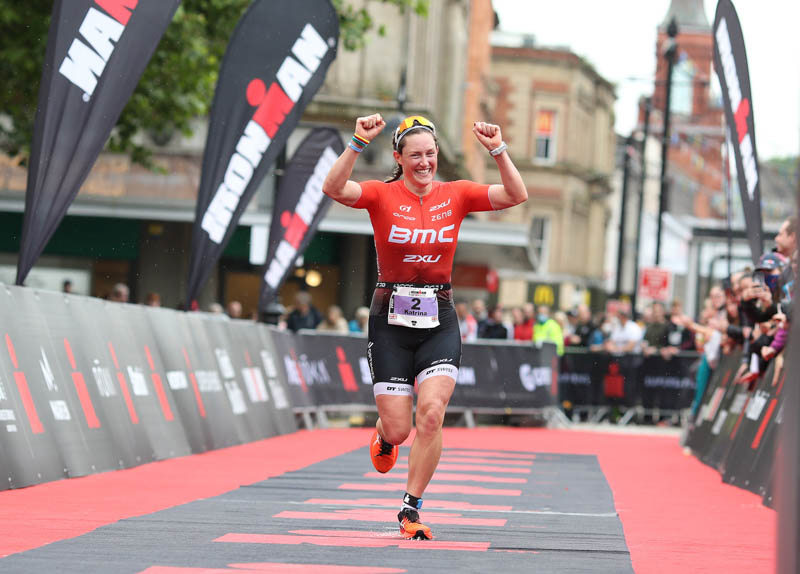
“I play that a little bit with my tummy and just see how things go,” she said. “I obviously include caffeine throughout the bike and run. And then, again, a little bit extra, like Raw salt as well, into a premix bottle in my personal needs.”
What does the fastest female Ironman athlete eat post-race, coming off of breaking the all-time record?
“And then afterwards … all the foods,” she said with a laugh.
Winning at intra-fuelling strategies
Matthews has been candid over the years about her nutrition in general. In 2022, she gave an interview with Effortless Swimming, in which she revealed a game-changing shift she made when it came to nutrition and a fuelling her training sessions. She had come to accept that she had not been adequately fuelling her workouts, and even started taking carbohydrates in her water bottle to swim sessions following this revelation.
“I now don’t go to a swim session without at least 25g of carbs in my water bottle. I’ve spent my whole life thinking it’s just a swim, that I’ve already had at least 50-60g that day in my bottle for the bike, I’m not to drink more sugar for the swim,” she reflected.
Optimizing those details for yourself is key, she explained. Choosing to fuel your sessions rather than scrimping during workouts, then eating more at meals, or eating meals for frequently is a choice. Calories consumed during a session will raise the quality of that session, so investing nutritionally there, versus outside of training, can take your performance to the next level.

Dialling in carbs in training
“Would you prefer to swim better or would you prefer a meal out in the evening? Find your own balance and optimize how you want to,” she offered.
“You get more out of it, especially long term, if you work out that answer for yourself. I feel like I’ve worked out that I need to do “x” amount of swimming, or that I need to do at least a VO2 session. Therefore, it’s in my control. I decided this. I’m going to implement this. That empowerment is crucial.”
Since fuelling sessions better across all three sports, Matthews said she’s no longer coming out of a session feeling hungry. She used to constantly need to respond to that by adding in more food throughout her day, or going being really hungry when going out to dinner.
“Now, I think, I’m eating much less during the day but making sure that I’ve got the sugar during the sessions. It sounds so simple, but it’s been massive.”
As the carbohydrate pendulum continues to swing farther towards increased hourly consumption, and athletes continue to learn how to get the most of themselves during training sessions, records will continue to be broken. We haven’t yet found the ceiling, but with extreme limits, such that Wurf has achieved at 200g of carbohydrates an hour, there’s seemingly no limit.
The post 200g of carbs per hour? Ironman pros break records with extreme fuelling strategies appeared first on Triathlon Magazine Canada.