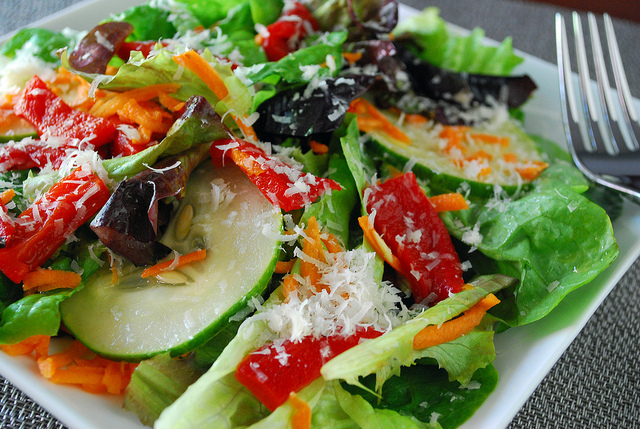
Anti-vaccine Health Secretary Robert F. Kennedy Jr. has made it one of his top priorities to convince Americans to “eat real food,” including more fresh fruits and vegetables. But, it’s a hard sell when those real foods are causing real eruptions of explosive diarrhea across the country.
The Food and Drug Administration is investigating six outbreaks of foodborne diarrheal illnesses caused by Cyclospora, a unicellular parasite known for spreading from human feces onto fresh produce. Past outbreaks have been linked to leafy greens, fresh basil, fresh cilantro, snow peas, green onions, and raspberries. The Centers for Disease Control and Prevention has tallied a record high of over 11,500 confirmed and probable cases across 41 states, with over 300 requiring hospitalization. And that case total is almost certainly an undercount.
The largest of the outbreaks is linked to Taylor Farms’ iceberg lettuce that was sold at Taco Bell restaurants and many other companies. The outbreak has sickened thousands of people across nine states, up from five states identified last week. One of the affected states is Michigan, which alone has reported 9,253 cases as of July 27. The other five outbreaks have no identified source.
Given the situation, it’s no surprise that a CBS News poll over the weekend found that about 40 percent of Americans are now buying or eating less produce amid the outbreak. Only 4 percent reported they were following Kennedy’s guidance of eating more.
The finding appears to be a setback to Kennedy’s Make America Healthy Again agenda, which has typically focused on overhauling nutrition guidance while neglecting food safety and infectious diseases.
Under Kennedy’s leadership, the FDA and CDC have both suffered draconian budget cuts and been drained of experienced career staff who know best how to identify, respond to, and effectively inform the public about such outbreaks. The CDC has lost about 25 percent of its staff, while FDA is down about 20 percent, CBS has reported.
Last year, the FDA also announced that it was delaying a new rule on food traceability, which would have made it easier for FDA investigators to identify and remove from the market foods linked to illnesses, such as Taylor Farms’ lettuce.
“Catastrophic” mismanagement
Last week, Kennedy claimed that the Cyclospora surge was “under control,” but critics and former FDA officials have scoffed at the statement.
“If history is any judge, when the Trump administration declares a crisis ‘under control’, it’s time to brace for the worst yet to come,” Brad Woodhouse, president of the public health nonprofit Protect Our Care, said in a statement.
Frank Yiannas, who served as FDA’s deputy commissioner for food policy and response in the first Trump administration and under Biden appeared equally skeptical. Yiannas has publicly called for an independent investigation into the federal government’s handling of the Cyclospora outbreaks.
“This one deserves a lot of questions, and it is starting to approach a catastrophic level in terms of how mismanaged it’s been on multiple fronts,” Yiannas told Politico. As examples of the mismanagement, Yiannas noted the outbreak’s extreme size—already well over double the typical number of cases seen in recent years—as well as mixed messaging and confusion among consumers. He also said there was a “lack of strong federal leadership.”
Susan Mayne, who served as director of the FDA’s Center for Food Safety and Applied Nutrition from 2015 to 2023, said the explosive outbreak was a “wake-up call” on the interconnectedness of food safety and nutrition. In an op-ed published in Stat, she noted seeing people online turning to processed foods that they now considered safer than salads and produce—such as pizza, bagged chips, and store-bought cookies—foods Kennedy has tried to steer Americans away from.
But “Oreos never gave me explosive diarrhea!” one person said, according to Mayne.
“Consumers should not be faced with a trade-off between nutrition and food safety—health is made possible when food safety supports consumer confidence in fruits and vegetables,” Mayne wrote. “‘Real foods’ are vulnerable to real pathogens.”