Conditional loan
The US military seems to be getting nervous about the launch supply crunch
“Launch is extremely constrained and that is exactly the situation we predicted.”
Credit:
Stoke Space
Credit:
Stoke Space
The US military is taking a new approach to prop up commercial launch companies as SpaceX looks to wind down its Falcon rocket program, suggesting defense officials see the workhorse rocket’s retirement as a potential national security risk.
The Pentagon’s Office of Strategic Capital has twice in the last two weeks announced it was sending cash to two of SpaceX’s competitors in the launch business. First, on October 26, the office announced a $150 million conditional loan commitment to Stoke Space. Military officials revealed a second $150 million Pentagon loan Tuesday for Rocket Lab.
Stoke Space and Rocket Lab are the first two launch companies to receive significant support from the Office of Strategic Capital (OSC), an organization established in 2022 to infuse companies developing “vital” national security technologies with capital. OSC has been on a loan spree in recent weeks, committing hundreds of millions of dollars to companies specializing in batteries, drones, and semiconductors. In the space sector, the office also provided a $150 million loan to LeoLabs, a commercial satellite tracking company, for production and deployment of radar units.
SpaceX, the Pentagon’s leading launch provider, has stopped taking commercial orders for Falcon 9 launches after 2028 as the company shifts its focus to the next-generation, super-heavy-lift Starship rocket. Falcon 9 and Falcon Heavy launches for government customers, including NASA and the US Space Force, are expected to continue a while longer. The Space Force’s launch contract with SpaceX allows the military to place Falcon 9 and Falcon Heavy orders through 2029, with the actual launches extending through 2033.
Then, if Starship is fulfilling its promise, SpaceX plans to retire Falcon for good. Starship may eventually be capable of launching national security payloads, but SpaceX’s near-term priority is using the rocket’s massive cargo capacity for its own Starlink Internet satellites and Starmind orbital data centers.
Assuring access to space
Military space officials have held to a policy of assured access to space since the 1990s, with the Pentagon paying to support at least two US rocket programs capable of launching national security satellites. The support previously came in the form of direct subsidies, development funding, and launch contracts at premium prices to give the government technical and financial insight into their launch providers, schedule priority on their launch manifests, and, in some cases, to simply keep them in business.
The Space Force’s mix of launch providers today consists of SpaceX’s Falcon family and United Launch Alliance’s Vulcan rocket, which has been grounded twice in the last two years by problems with its solid rocket boosters. ULA’s woes with Vulcan forced the Space Force to shift several national security missions to SpaceX.
Other launch providers aim to compete for their own slices of the growing pie of Space Force launch contracts. Space Systems Command, which oversees launch procurement for the Space Force, now forecasts the military will require up to 249 medium-to-heavy-lift launches through the early 2030s from its roster of launch contractors, more than double the command’s expectation just two years ago.
Alongside SpaceX and ULA, Space Systems Command has tapped Blue Origin, Rocket Lab, Stoke Space, Relativity Space, and Impulse Space for eligibility to compete for some of those national security launches. Blue Origin is the only company that has flown a rocket that could meet the Space Force’s requirements. Rocket Lab, Stoke Space, and Relativity Space are developing their own medium- and heavy-lift launch vehicles, while Impulse Space is working on in-space propulsion.
The loans from the Pentagon’s Office of Strategic Capital aim to get new medium-class rockets from Stoke Space and Rocket Lab ready to meet the military’s needs.
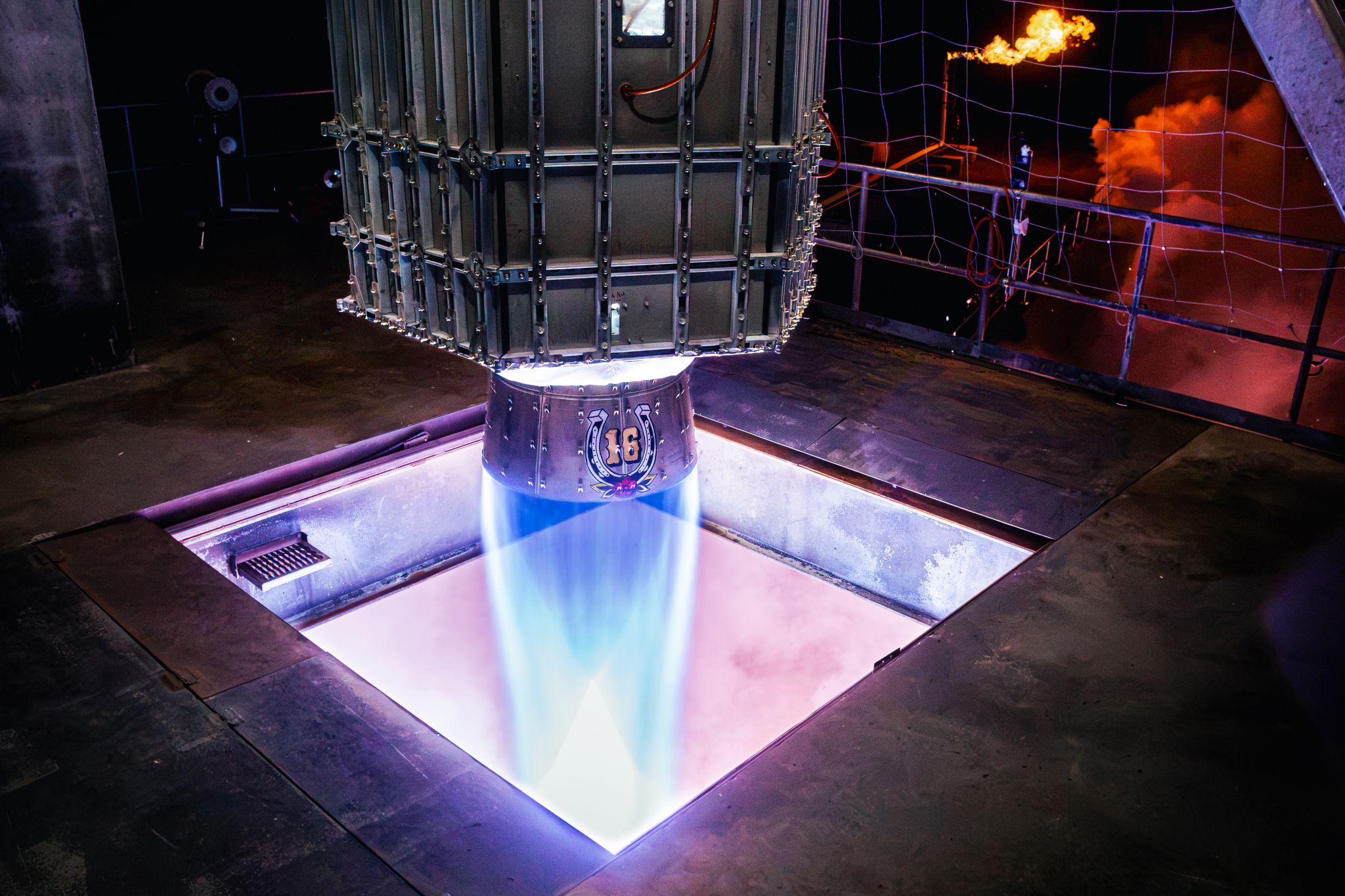
Stoke Space’s loan is tailored to support the buildout of the company’s second launch pad at Cape Canaveral Space Force Station, Florida. The second launch site would support flights of Stoke Space’s Nova Block 2 rocket, an upgraded version of the company’s fully reusable Nova Pathfinder, which is set to debut sometime next year.
“By supporting the construction of additional launch infrastructure, this commitment would enhance the overall capacity and resilience of the commercial space industrial base,” said Jordan Sebold, senior managing director of investments at OSC.
The loan to Rocket Lab will support the company’s efforts to increase the flight rate of its partially reusable Neutron rocket, which Rocket Lab says is also scheduled to make its first launch next year.
“The proposed loan would support faster vehicle delivery and processing and allow Rocket Lab to expand its fleet of maritime vessels with additional equipment for Neutron recovery and transport,” OSC said in a statement. “It would also enable manufacturing upgrades to increase the production of composite structures and engines, and support infrastructure that would reduce turnaround time between launches once the reusable rocket makes its operational debut.”
Both conditional loans are subject to “various financial, legal, technical, investment, due diligence, and other requirements,” OSC said.
Adam Spice, Rocket Lab’s chief financial officer, said Monday the Pentagon loan is on “very attractive terms” and “underscores the importance” of the military’s appetite for launch capacity.
“We always take it when we can get it,” Spice said in a quarterly earnings call. “It gives us additional capital to scale key parts of our business, Neutron in particular … I think this is a helpful indicator, a very positive indicator, about where everyone sees the demand constraint and how it can be unlocked, and capital is certainly a part of that.”
Rocket Lab also unveiled new pricing for the Neutron rocket—an increase from $55 million to $70 million per launch—in response to what the company said was a surge in bookings for the still-unproven launch vehicle. Rocket Lab said it now has a backlog of 117 launches on contract, including orders for Neutron missions and the company’s smaller Electron rocket.
“Launch is extremely constrained, and that is exactly the situation we predicted,” said Peter Beck, Rocket Lab’s founder and CEO.